The question of how music streaming services’ algorithms recommend songs is in the spotlight, in the wake of new statistics out of Australia/New Zealand showing a steep decline in the share of local music being streamed.

According to the latest Year in Review from music rights management org APRA AMCOS, the share of locally written or composed music streamed in Australia and New Zealand has fallen by 31% over five years, accounting for just 9.5% of music streams in the two countries in 2024-2025.
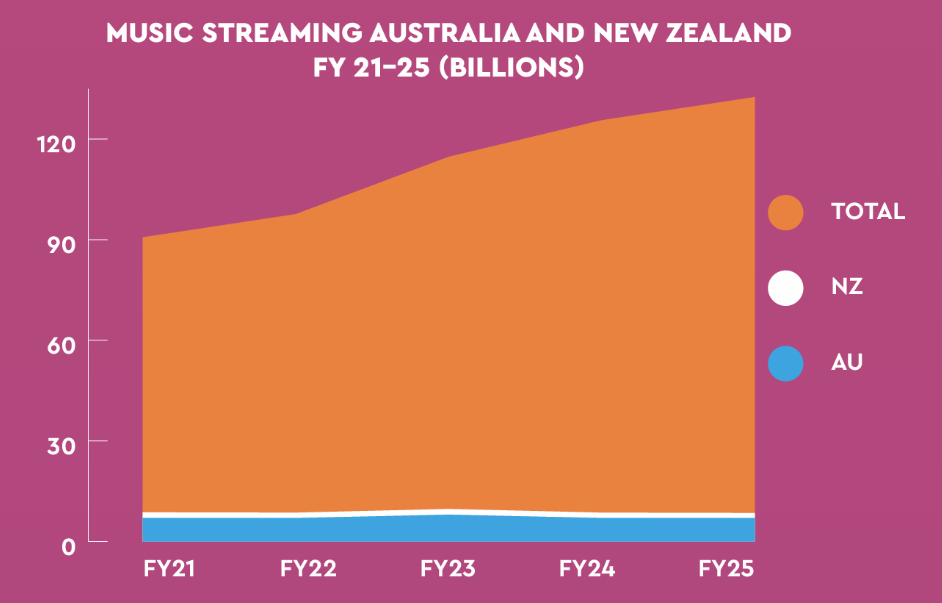
During that time, overall consumption of music on streaming and user generated content (UGC) platforms has grown by 50%, and APRA AMCOS’ revenue continues to grow, up 6.5% YoY in the latest fiscal year, to AUD $787.9 million (USD $513.3 million). Distributions to rights holders increased 7.8% YoY to AUD $683.4 million (USD $445.3 million).
Yet despite the increase in consumption and revenue, streams of local music have stayed flat.
APRA AMCOS CEO Dean Ormston suggested the problem may lie with streaming platforms’ algorithms.
“Australians and New Zealanders are world-leading music fans. We consume more music per capita than almost anywhere else on the planet, yet the ability for our members to be seen and heard is becoming more difficult every year,” Ormston said.
“This isn’t happening because our music isn’t good enough, and our surging export revenues prove our artists are among the best in the world. They’re writing hits, filling venues internationally and competing at the highest level. The talent is undeniable. Our platforms are borderless, but algorithms favor scale and international repertoire dominate by default.”
Underrepresentation of local acts has also been flagged as an issue in some European countries. In a recent interview with MBW, Believe Founder and CEO Denis Ladegaillerie suggested European lawmakers should look at why algorithmic recommendations are creating an Anglo-American monoculture in EU markets.
He pointed out that “28% of streams [are] from local artists in the UK, 36% in Germany, 41% in France.”
“Australians and New Zealanders are world-leading music fans. We consume more music per capita than almost anywhere else on the planet, yet the ability for our members to be seen and heard is becoming more difficult every year.”
Dean Ormston, APRA AMCOS
Ladegaillerie continued: “Our DNA as a company is to support the buildup of local ecosystems, so when I see that in the UK, local artists in 2024 represented just 28% of streams – that’s a killer for me.
“If the UK had the same rate of local artists as you see in the US, Japan, or Brazil at 60-70%, you’d almost triple the market size. That means more jobs, more local labels, more people. That gives you bigger [domestic] companies, more influence, and the ability to market.”
However, it’s not entirely clear whether streaming algorithms are the problem; some data suggests the exact opposite.
Recent research by music economist Will Page found that countries like France, Germany and Italy are benefitting from a “glocalization” trend that has seen local acts come to dominate the top of the charts, controlling at least 75% of local streams in 2023.
But these acts seem to be dominating the top of the charts, and not so much the middle. In Germany, for instance, despite eight of the Top 10 acts being local in 2023, Luminate data showed that local acts accounted for only 43% of the top 1,000 streams the following year.
And Latin America’s music scene has come to be dominated by Latin music (though not necessarily local acts in each country), according to data from Spotify.
Page’s research suggests that, at least in some respects, streaming has improved the market position of local acts. The economist noted that, in Germany in 2023, while 80% of the top acts on streaming were local, not a single one of the top 100 radio airplay songs were local.
Nonetheless, Ormston is urging Australian and New Zealand policymakers to support the local music industry in the wake of its shrinking streaming share.
“We must continue to bang the drum as loud as we can for our members and advocate for their rights,” he said, including “campaigning for live music tax offsets and the importance of being seen and heard.”Music Business Worldwide