MBW Reacts is a series of analytical commentaries from Music Business Worldwide written in response to major recent entertainment events or news stories. Only MBW+ subscribers have unlimited access to these articles. The below originally appeared in Tim Ingham’s latest ‘Tim’s Take’ email, issued exclusively to MBW+ subscribers.
Mikey,
It’s been a hell of a week.
First your baby, Suno, was credibly accused of becoming a “fraud-fodder factory” by a group of artist representatives.
Then you confirmed the ex-CEO of Merlin, Jeremy Sirota, as Suno’s new Chief Commercial Officer. Sirota once stated that “independent music is not raw material for tech companies to exploit without consent”. He was right… then.
But the pièce de résistance came on Wednesday, when you announced that Suno’s annual revenue run rate has hit $300 million, via 2 million paying subscribers.
$300 million divided by 2 million subscribers equals an average annual spend per user of $150.
That’s interesting.
It tells us that a hefty chunk of your subscriber base is paying for your pricier top tier: Premier. The one that lets someone make 2,000 songs a month, or roughly 66 per day.
What might appeal to Suno’s users about this industrial scale of production?
I suspect we know, Mikey.
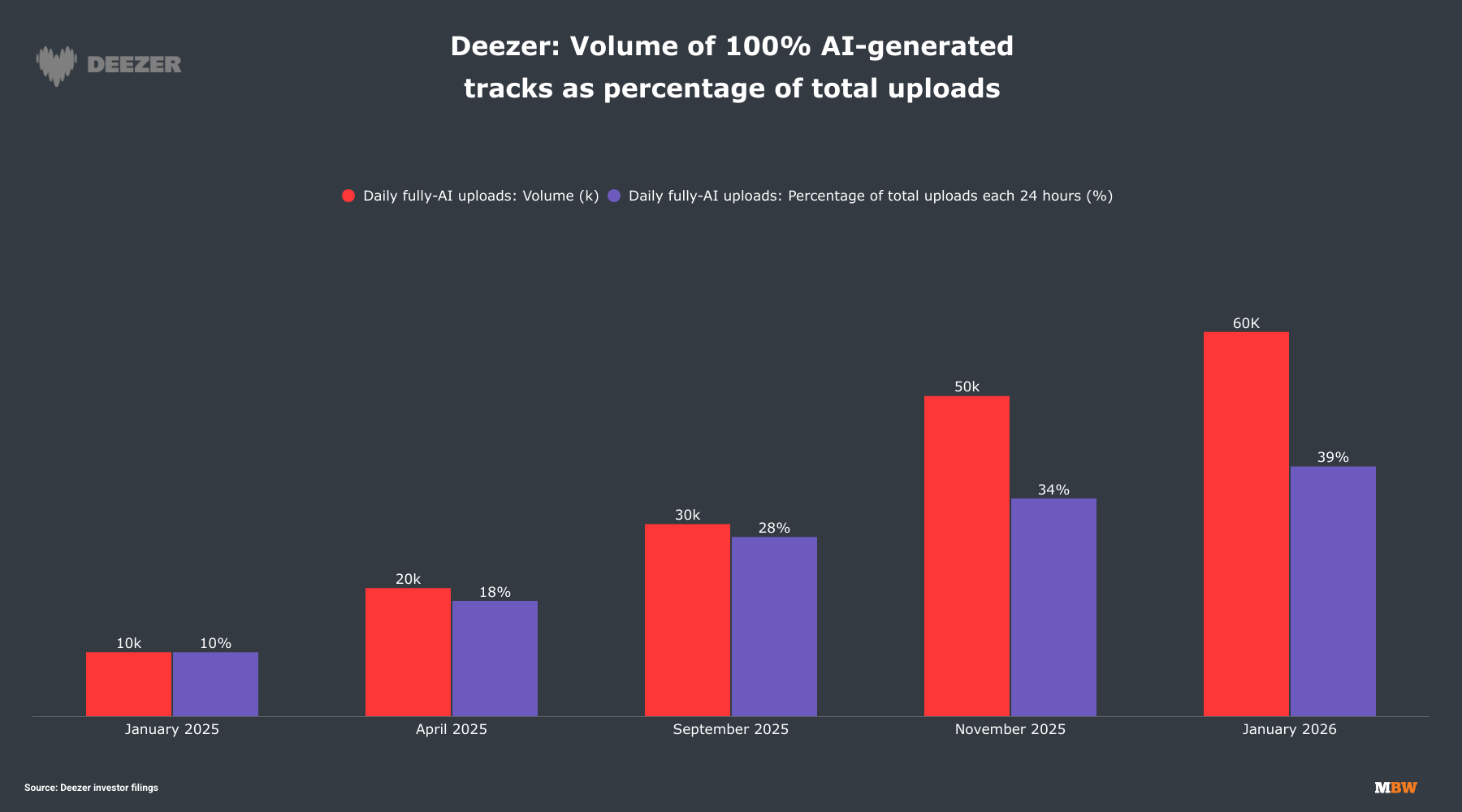
We know because Deezer’s data tells us that 39% of the music uploaded daily to DSPs is now fully AI-generated.
We know because Deezer also tells us that up to 85% of the streams on this AI music are fraudulent — generated by streaming farms and other illegitimate means.
We know when we watch YouTuber Mr. Money’s video on How To Make Money With Suno AI Songs On Apple Music.
And we know when Reddit’s ‘Passive Income’ forum proudly explains how to pull in $5k a month from DSPs using Suno songs.
These people are gleefully sucking money from streaming’s royalty pool — a pool funded by the subscription fees of real music fans, who believe their money is going to real artists.
Suno is a key engine in the process behind this royalty heist. And business is booming.
Yet my primary reason for writing isn’t to point fingers, or have ridiculous debates about DRM and ‘walled gardens’.
It’s to sound an alarm.
Right now, with Suno being sued by Universal and Sony for mass copyright infringement, you’re in a race. A race to $1 billion in annual revenue. A race to become too big to fail.
Your Warner deal has bought you some time in this mission. Even though, three months on from its announcement… we’re yet to see any evidence of the “licensed models” you promised would arrive in 2026, trained on WMG’s catalog.
(Has it perhaps dawned on you that this deal only legally clears Suno to train on a relatively thin stratum of copyrights – where WMG controls 100% of both the recording and the publishing rights?)
Meanwhile, Universal and Sony are building a robust case against you.
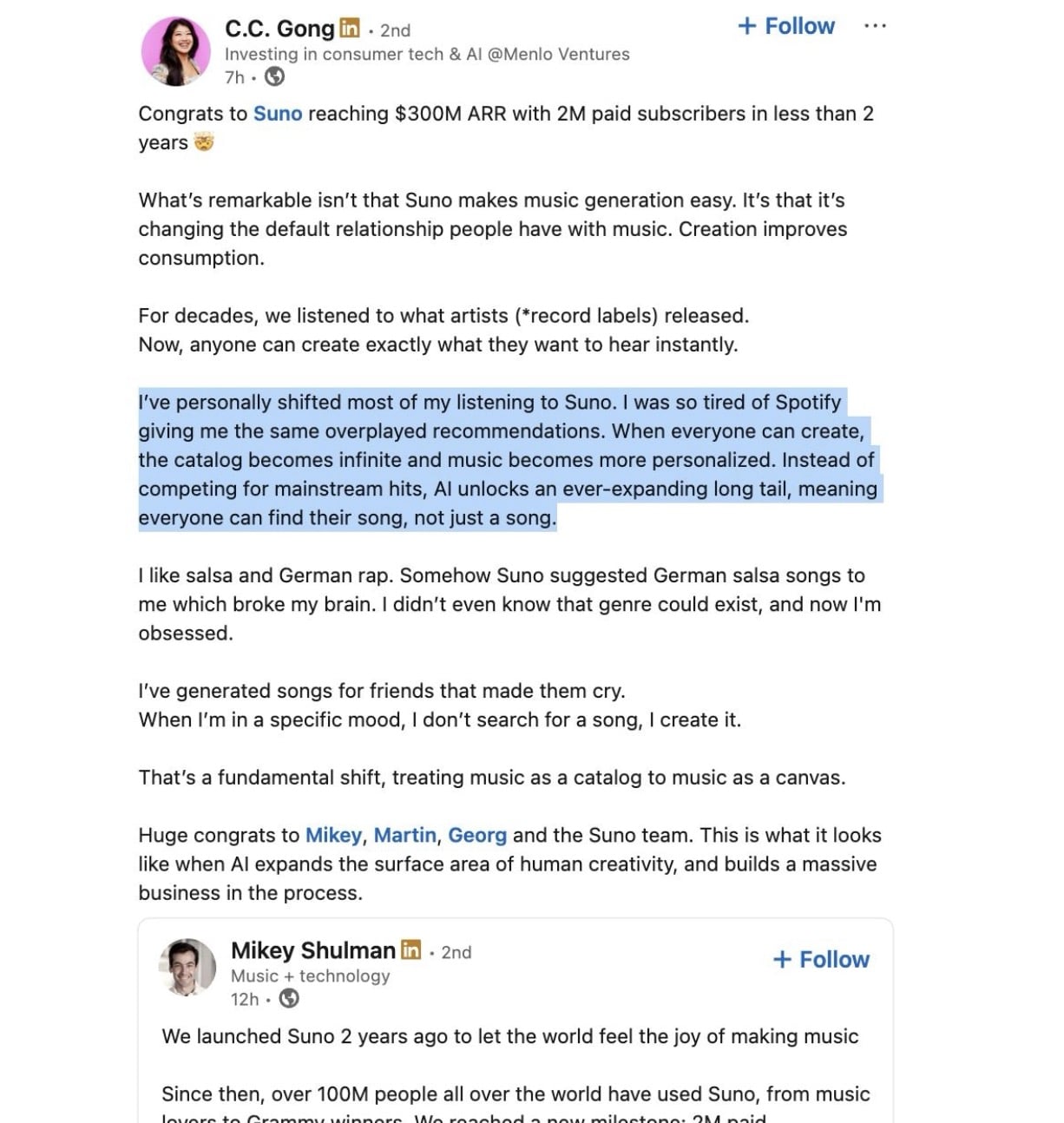
This week, a Principal at Suno investor Menlo Ventures — C.C. Gong — handed them a gift.
In a LinkedIn post celebrating your subscriber milestone, Gong wrote that she had personally “shifted most of my listening to Suno” because she was “so tired of Spotify giving me the same overplayed recommendations”.
Read that again: the lead investor in your $250 million Series C is publicly stating that Suno is a substitute for Spotify.
A key part of your ‘fair use’ defense vs. these majors rests on the argument that Suno’s output creates something fundamentally new, not a replacement for existing music.
Your own investor just told the world it is a replacement.
Gong’s LinkedIn post has now mysteriously disappeared. But the internet never forgets.
Last year, I speculated that Spotify might eventually acquire Suno — making you rich, your investors whole, and the platform legitimized in one fell swoop.
But this outcome is becoming increasingly unlikely.
For one, you’re too expensive. At a $2.45 billion valuation, you’re a heavy lift for Spotify, whose own investors care deeply about margin expansion.
At the same time, we know that Spotify isn’t always great at building its own music-adjacent products (remember Car Thing?).
Where Spotify has succeeded in product development is via M&A targets — namely Gimlet and Anchor — that it’s absorbed and scaled. On-the-rise platforms whose value can only be fully realized within Daniel Ek’s castle.
You know what else fits that description? Udio. Which is handily already licensed by Universal, Warner, and Merlin.
Google just made a similar move, buying (drum roll) an on-the-rise Suno rival, ProducerAI.
If Spotify — with its 751 million users — now swoops, integrating Udio’s tech into its own ecosystem, where does that leave Suno… and that handsome valuation?
Not to mention: Suno’s appeal to royalty-farmers evaporates when DSPs begin implementing AI detection and de-monetization at scale.
I also want to speak to you, Mikey, on a cultural level.
Everyone knows your most memorable quotation: when you said that making music the traditional way “is not really enjoyable” vs. Suno because it “takes a lot of time, a lot of practice”.
But that comment just scratches the surface of your investor sell, the basis of which is, in essence: music alone is not enough.
Example: You once described how Suno offers “meaningful consumption experiences” to its users.
In our business, we call those songs, but you do you.
Yet that couldn’t top your most stupefying claim: “To me, it seems crazy that music should not be as engaging as Fortnite.”
Mikey. How can I put this?
They don’t play Fortnite at people’s funerals.
Which brings me to Suno’s new TV adverts.
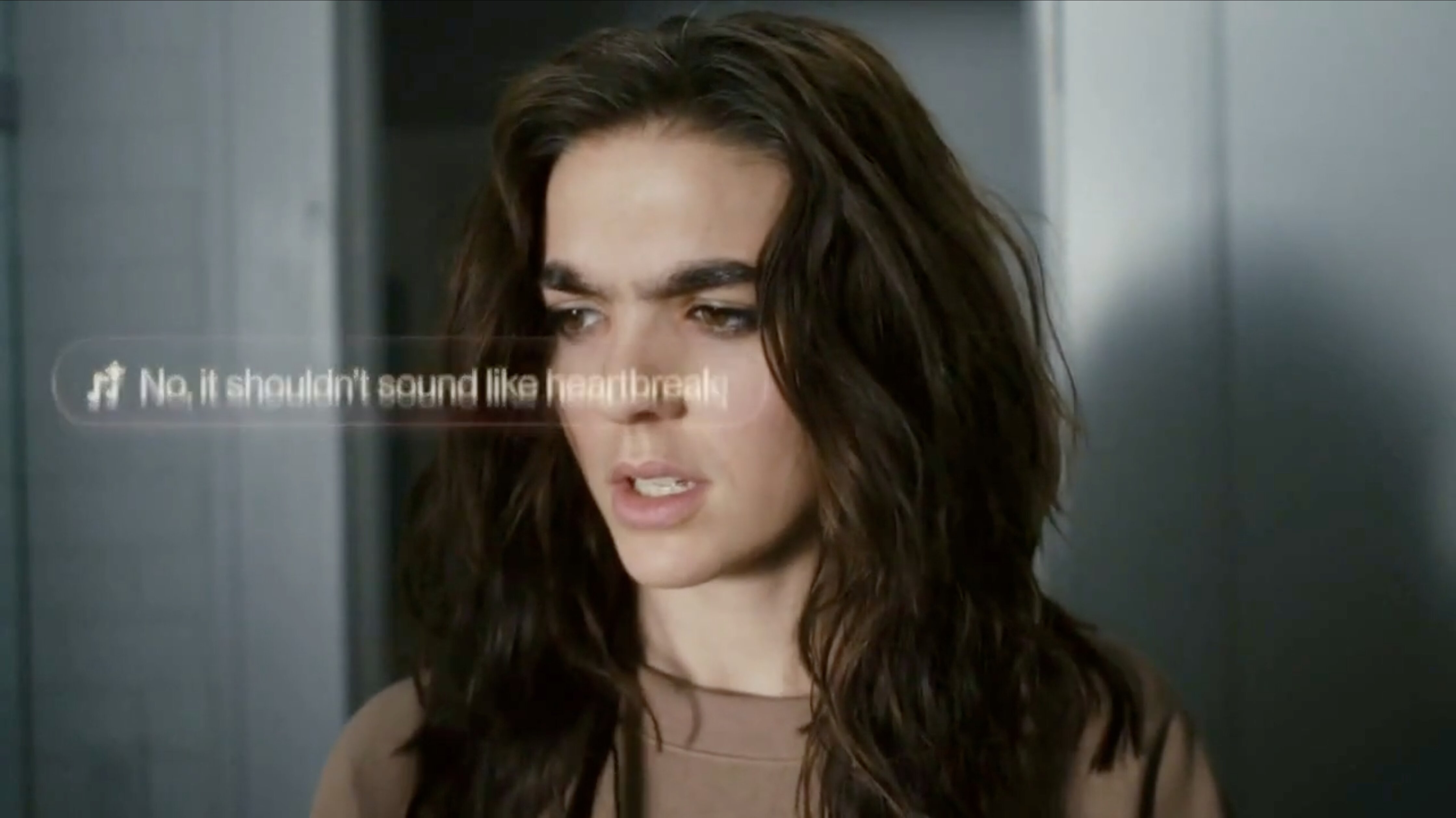
In one, a woman sits in a bathroom cutting her hair with scissors.
“This is a song about a breakup,” she tells Suno. A mournful tune begins to play. She pauses. “No, it shouldn’t sound like heartbreak. More like taking control.”
The track shifts into something punky, defiant.
In another, a young man smiles and says, “This is a song about my first kiss.” A Pharrell-esque groove kicks in. He reconsiders. “It should sound more exciting — like the best day of my life.” The beat swells accordingly.
These are supposed to be Suno’s emotional proof points. A demonstration of its ability to perfectly soundtrack life’s most intimate human moments.
And yet: they don’t showcase anything that Alexa and Spotify couldn’t match.
What these people are doing is reaching for something that offers the surface of real emotion without the substance of it.
No lived experience. No actual heartbreak. No scars.
Just a machine that’s learned what those things sound like — by ingesting the work of humans who actually felt them.
It’s a simulacrum, Mikey. A grubby facsimile of human connection.
Walk around central Amsterdam, and you’ll spot people selling a similar illusion.
Stood under red lights, with sad eyes.
P.S. I wrote you a song. Well, Suno did. Mining vast chapters of the history of music.
I hope you like it. It’s called Meaningful Consumption Experiences.
Music Business Worldwide