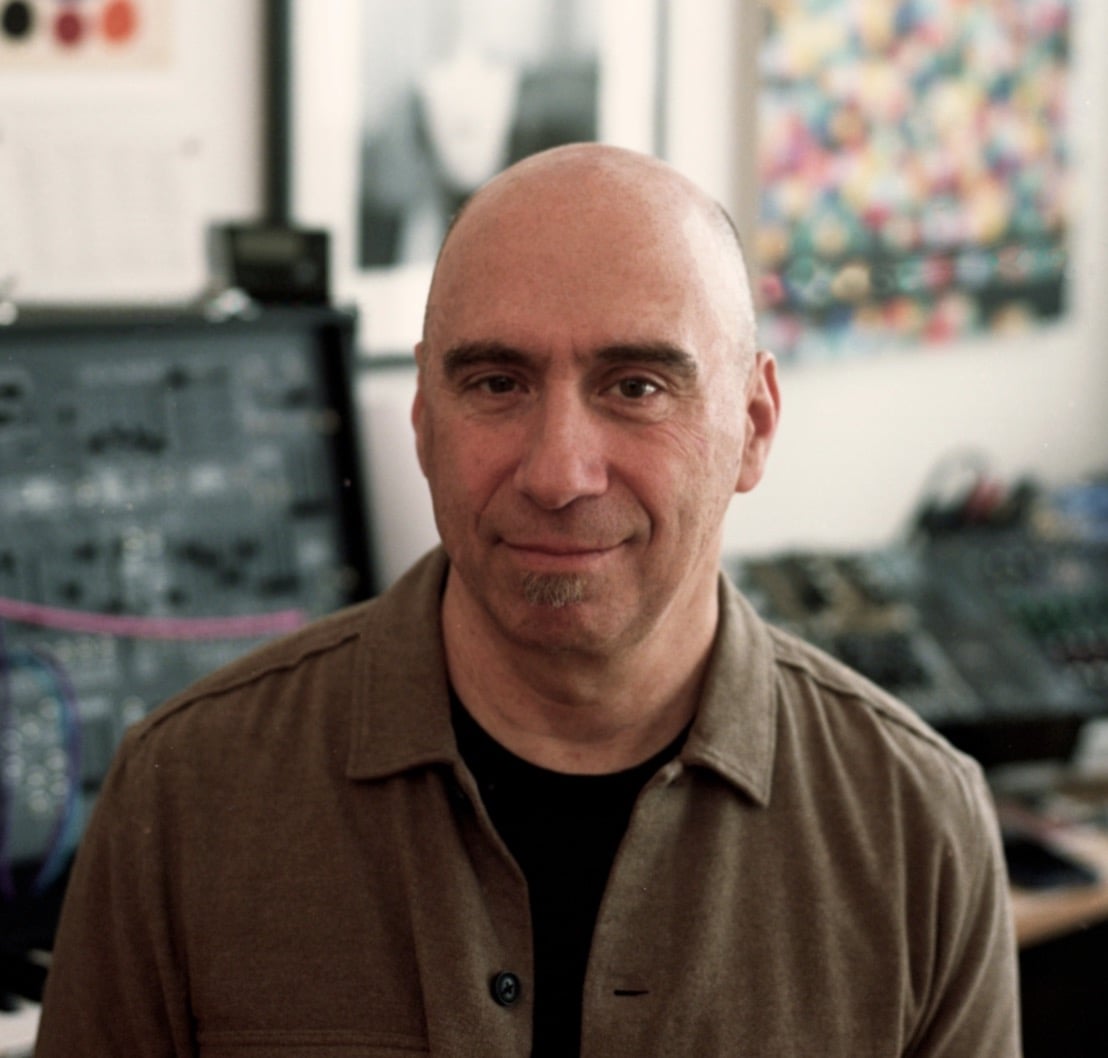
The following MBW op/ed comes from Joel Goodman (pictured inset), an Emmy-winning composer who has scored more than 150 films and TV shows, and who also works as a music publisher.
Here, Joel argues that if AI companies win the right to train on copyrighted works without permission or payment, creative work could become infinitely abundant while creativity itself becomes economically irrelevant.
It seemed to be an ordinary day, but as I walked into the classroom, I saw something that took my breath away. I had seen it before, in magazines, but this was the first time I saw it in person. It was a Synclavier, one of the first sampling synthesizers and digital music workstations. As we explored its sounds I could feel, and hear, a whole new world of music opening for me.
The teacher in that classroom, Chris Noyes, played a role in the Electronic Music Department that would eventually become the Music Synthesis Major at Berklee College of Music in Boston. This was the time when MIDI was born, the computer language that enabled synthesizers, drum machines and sequencers to talk to each other. Their connection to computers, less than a year away, opened a whole new way to record and manipulate sound and music. The musical possibilities seemed limitless.
I studied composition, orchestration and arranging, and as I launched my career in music, first writing music for TV commercials, digital technology was gaining a foothold. I benefited from that. I remember when sampled phrases and loops were starting to be used, and how I felt that in a way, it was cheating.
Producers already understood the tech and were asking for finished pieces faster. I learned the same was true as I began scoring films and television. So, if I wanted to be successful in the competitive world of scoring to picture, I would have to use those tools too. In time these samples became the creative building blocks that many artists used to create wonderful, unique music that we still enjoy today.
I’ve watched computers turn recording studios into laptops, orchestras into samples, and technologies that once seemed revolutionary become ordinary. I’ve always embraced technological change. None of those changes worried me. Generative AI does.
In the summer of 2025, a folk-rock band called The Velvet Sundown climbed Spotify’s Viral 50 chart, landed on playlists saved by hundreds of thousands of users, and released four albums in less than two months. There was just one problem: the band didn’t exist. No members, no studio, no shared history, just AI-generated music, AI-generated photos and an AI-generated backstory, distributed like any other artist and earning real streaming royalties along the way. By the time the ruse was exposed, Velvet Sundown had more than a million monthly listeners: attention, and revenue, that would otherwise likely have gone to actual musicians.
I’ve spent my adult life creating music for a living. Like every creator, I have borrowed, absorbed and learned from the music that came before me. That’s how culture works. But there’s a world of difference between a human being influenced by a piece of music and tech companies scraping and ingesting millions of copyrighted works to build commercial systems that generate derivative music. That distinction is at the heart of one of the most consequential questions facing creative people right now.
What concerns me is that we are beginning to confuse the ability to generate something with the ability to create something meaningful. Technology has always changed how humans make music, but it never eliminated the human need to make it. Generative AI is different. These systems can produce new material rather than simply helping a human produce it. That difference has enormous economic and societal implications.
Throughout my career I’ve faced shrinking budgets and had to be creative and entrepreneurial to keep doing what I love. That’s what led me to become a music publisher. Now I was hiring composers and learning what it was like to be the client. I’m protective of our composers and committed to doing right by them. Knowing that our work has very likely been scraped to create the technology that will replace some of the licensing we’ve done is a bitter pill to swallow, and it makes me angry.
“Knowing that our work has very likely been scraped to create the technology that will replace some of the licensing we’ve done is a bitter pill to swallow.”
I have seen what happens to the music and film industries when new technologies arrive. Budgets come under pressure and the pool of jobs gets smaller. If technology makes something faster or cheaper, the industry expects the same work to cost less. This is not unique to musicians, but the current debate is about something bigger than the number of jobs available to composers, musicians, writers or artists. It’s about what we believe creativity is worth.
That question has become urgent because of the legal battles over whether AI companies can use copyrighted works to train their systems without permission or compensation. The Justice Department has now taken a position supporting the AI companies’ fair-use arguments.
Suppose they prevail. A company could use enormous quantities of human-created music, books, images, and other creative work as raw material for a commercial system, without compensating the people who made it or the people who own it, and that system could then produce an unlimited supply of new creative works. What happens to the value of the original work? More importantly, what happens to the incentive to create it?
Copyright has never guaranteed success. It simply provides a framework in which creators can retain some control over the economic value of what they make, and that principle has made it possible for generations of writers, musicians, filmmakers and artists to devote their lives to their work. If we fundamentally change that bargain, we should consider the consequences.
The danger isn’t that humans will stop creating. Humans have always created, even under terrible circumstances. The danger is that fewer people will be able to make a living doing it, and that could change culture itself.
For years I have been concerned for younger composers, especially those at the start of their careers. AI has shed a new light on that concern because it’s eroding the early commercial work that shaped me and contributed to my success.
There are also studies raising concerns about AI-induced cultural stagnation and homogenization. A machine can generate an enormous amount of competent material, but culture doesn’t advance simply by producing more of it. Culture advances when human beings take risks, experiment, fail, make unexpected connections and create things that didn’t previously exist.
“The danger isn’t that humans will stop creating. Humans have always created, even under terrible circumstances. The danger is that fewer people will be able to make a living doing it, and that could change culture itself.”
We are already becoming accustomed to getting more of our lives through prompts, asking machines for answers, images, music and writing. The convenience is extraordinary, but convenience has a cost when it begins to replace the experience that produced the thing in the first place.
For me, the excitement of composing isn’t just hearing the finished piece. It’s figuring out what the next note should be, or how the next chord will affect the emotional quality of the piece. When uncertainty, surprise and discovery are removed, the music and the experience flatten. As with many things in life, the journey is where the richness lies. Art is the expression of a person’s lived experience, not simply the production of an object. When we create or experience something meaningful, we feel something difficult to quantify but fundamental to being human.
I’m an optimist. There may be a silver lining here. Surveys suggest people are not nearly as enthusiastic about AI-generated music as tech companies might assume. More than half of Americans say they aren’t interested in listening to AI-created music, even when it’s made by their favorite artist.
Most believe AI companies should obtain an artist’s permission before training on their work, and younger generations are no exception. Many Gen Z respondents have learned to play an instrument or want to learn more about music. Perhaps they don’t want to be told a machine can do it for them.
Filmmakers come to me for something only I can give them, my authentic voice. I wonder whether AI might ultimately make genuinely human music more valuable. At some point AI might be able to produce massive quantities of competent music, and when competent music becomes ubiquitous, its economic value will diminish.
What becomes scarce and therefore valuable is identity, experience, authenticity and human connection. AI may accelerate the decline of interchangeable music while increasing the value of music with a distinctive human voice. But that outcome isn’t guaranteed.
We should welcome technology that helps people create, but we should be careful about building technology that treats human creativity as an inexhaustible resource, something that can be taken freely, turned into a machine and used to compete with the people who made it.
If we make creative work infinitely abundant while making creativity economically irrelevant, we may discover that what we’ve devalued isn’t simply music, books and paintings. We’ve devalued the human impulse to create them.
Music Business Worldwide