A song that topped Spotify‘s Swedish charts has been banned from the country’s official rankings after an investigation revealed that it was created using artificial intelligence by a Danish music publisher.

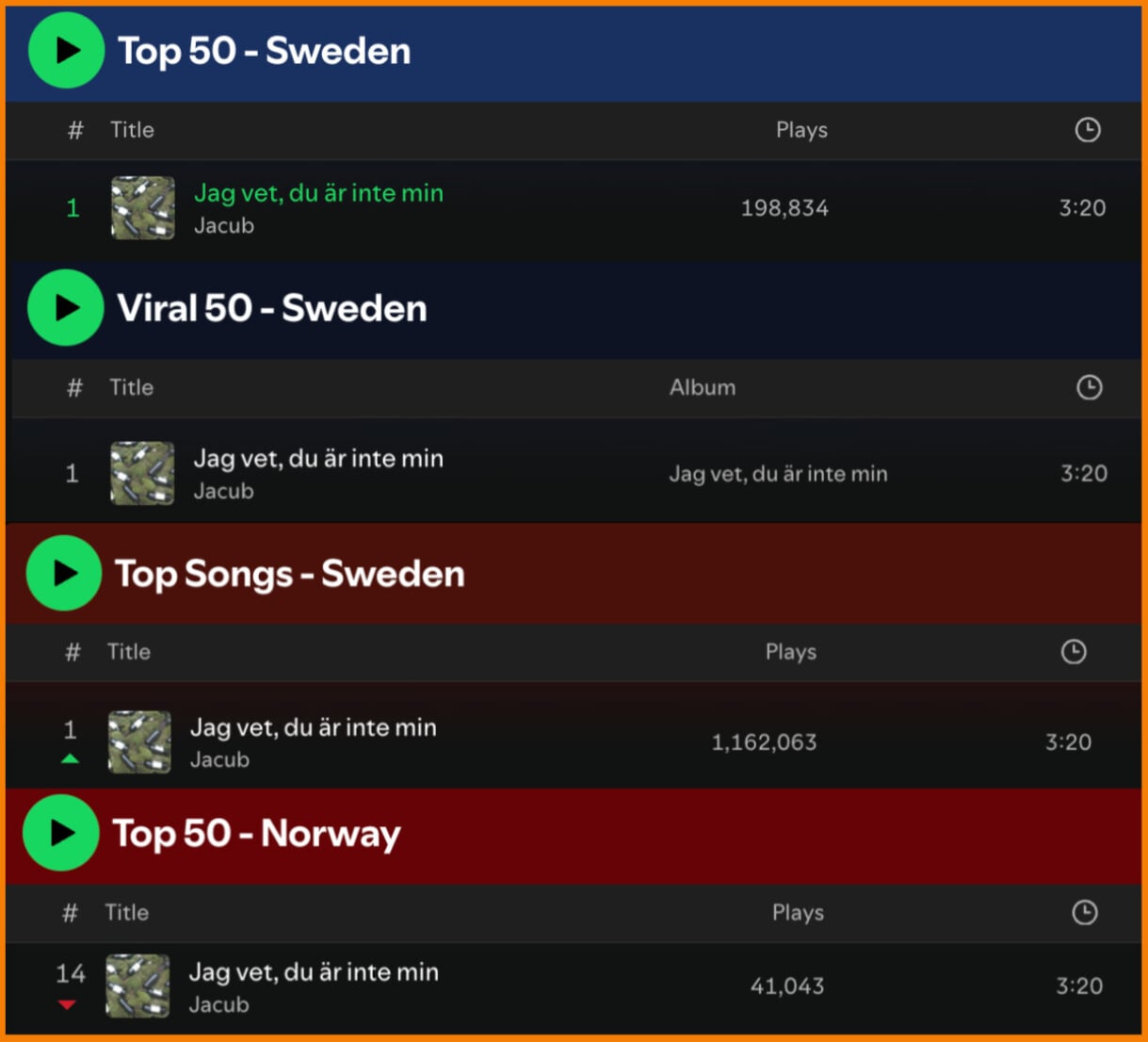
Jag vet, du är inte min by an artist called Jacub reached No. 1 on Spotify‘s Swedish Top 50 before music industry body IFPI blocked it from Sverigetopplistan. It also landed at No. 14 on Spotify’s Top 50 chart in Norway.
An IFPI Sweden spokesperson was quoted by The Guardian as saying: “Jacub’s track has been excluded from Sweden’s official chart, Sverigetopplistan, which is compiled by IFPI Sweden. While the song appears on Spotify’s own charts, it does not qualify for inclusion on the official chart under the current rules.”
IFPI Sweden’s Chief Executive Ludvig Werner added: “Our rule is that if it is a song that is mainly AI-generated, it does not have the right to be on the top list.”
On Spotify, the artist listed as Jacub has already gained over 935,800 monthly listeners, mostly in Sweden. The folk-pop song in question has amassed over 6.3 million plays on the platform.
“While the song appears on Spotify’s own charts, it does not qualify for inclusion on the official chart under the current rules.”
IFPI Spokesperson (via the guardian)
The exclusion came after Swedish journalist Emanuel Karlsten traced the song’s origins through STIM (Svenska Tonsättares Internationella Musikbyrå), Sweden’s music rights organization, according to a blog post. Registration records showed five people listed as authors, with four connected to Stellar, a Danish music publisher.
Stellar’s co-founders Morten Winther and Ryan Peterson appear as authors, alongside intern Malthe Carlsen. All three are based in Copenhagen, according to Karlsten. Another listed author, Niklas Engvall, is a Swedish graphic artist who creates AI-generated illustrations and publishes them on Instagram account @engvall.arts.
Karlsten wrote that Engvall and Carlsen are listed on Stellar’s website as responsible for an AI department that handles visuals.
“Our rule is that if it is a song that is mainly AI-generated, it does not have the right to be on the top list.”
Ludvig Werber, IFPI Sweden
The investigative journalist also identified a fifth author, Jacob Berg, whose name inspired the Jacub persona. Karlsten said Berg appears not to be connected to Stellar, but STIM records show he also created another song performed by Ingrid Eikeland, another artist believed to be AI generated.
Eikeland’s song Søsken, released in October, has so far amassed more than 102,300 streams on Spotify. Karlsten said Søsken is also registered at STIM by the same Stellar team, plus Lasse Fabricius, another co-founder at Stellar.
“Søsken thus seems to be a test of the Norwegian market, in the same way that Jag vet, du är note min seems to be a test of the Swedish market,” according to a translated text of Karlsten’s article last week (January 12).
In an email to Karlsten, which the journalist published, Stellar defended its work, describing their team as “experienced music creators, songwriters and producers who have invested a lot of time, care, emotions and financial resources into this EP.”
“it is important to clarify that we are not an anonymous tech company that has just ‘pressed a button.’ That could not be further from the truth.”
Stellar
They wrote (in Swedish): “First of all, it is important to clarify that we are not an anonymous tech company that has just ‘pressed a button.’ That could not be further from the truth.”
“The process has involved many late nights and a great deal of personal commitment, which is also why we are genuinely grateful for how strongly listeners have emotionally connected to the music.”
Stellar differentiated themselves against “AI music slop,” described as mass-uploaded tracks without artistic intent. The team claimed no paid advertising was used and that organic listener support drove the song’s success.
The music publisher also claimed to have identified nearly 100 songs that have attempted to replicate their approach.
“We don’t deny that it’s relatively easy to generate an AI song that almost no one listens to. However, we believe that it takes something completely different to repeatedly create songs that large numbers of people actively choose to return to,” they said.
They also denied allegations that their prompts for the Jacub song referenced Swedish artist Albin Lee Meldau, who currently has over 1 million listeners on Spotify.
They explained: “That claim is factually incorrect. The artist in question has not been referenced at any time in the prompts, reference materials, or in the creative process behind Jag vet, du är note min or any of our other releases. The songs have been created through a human-driven process with full creative control, where AI music tools have only been used as assisting instruments.
When asked whether Jacub exists, Stellar wrote: “Jacub is an artistic project developed and carried by a team of human songwriters, producers, and creators. The feelings, stories, and experiences in the music are real, because they come from real people.”
“Jacub is an artistic project developed and carried by a team of human songwriters, producers, and creators. The feelings, stories, and experiences in the music are real, because they come from real people.”
stellar
The news arrives four months after STIM launched what it called “the world’s first collective AI license” that allows tech companies to train AI models on copyrighted works in return for royalty payments.
During the launch, STIM’s Acting CEO Lina Heyman said: “With the world’s first collective AI license, we show that it is possible to embrace disruption without undermining human creativity.”
“Behind every model lies human works whose value must be respected. By embedding the AI Act’s core principles—transparency, traceability and fair pay — into practice, we protect creators and show that for AI firms, compliance must be a competitive edge.”
Music Business Worldwide