

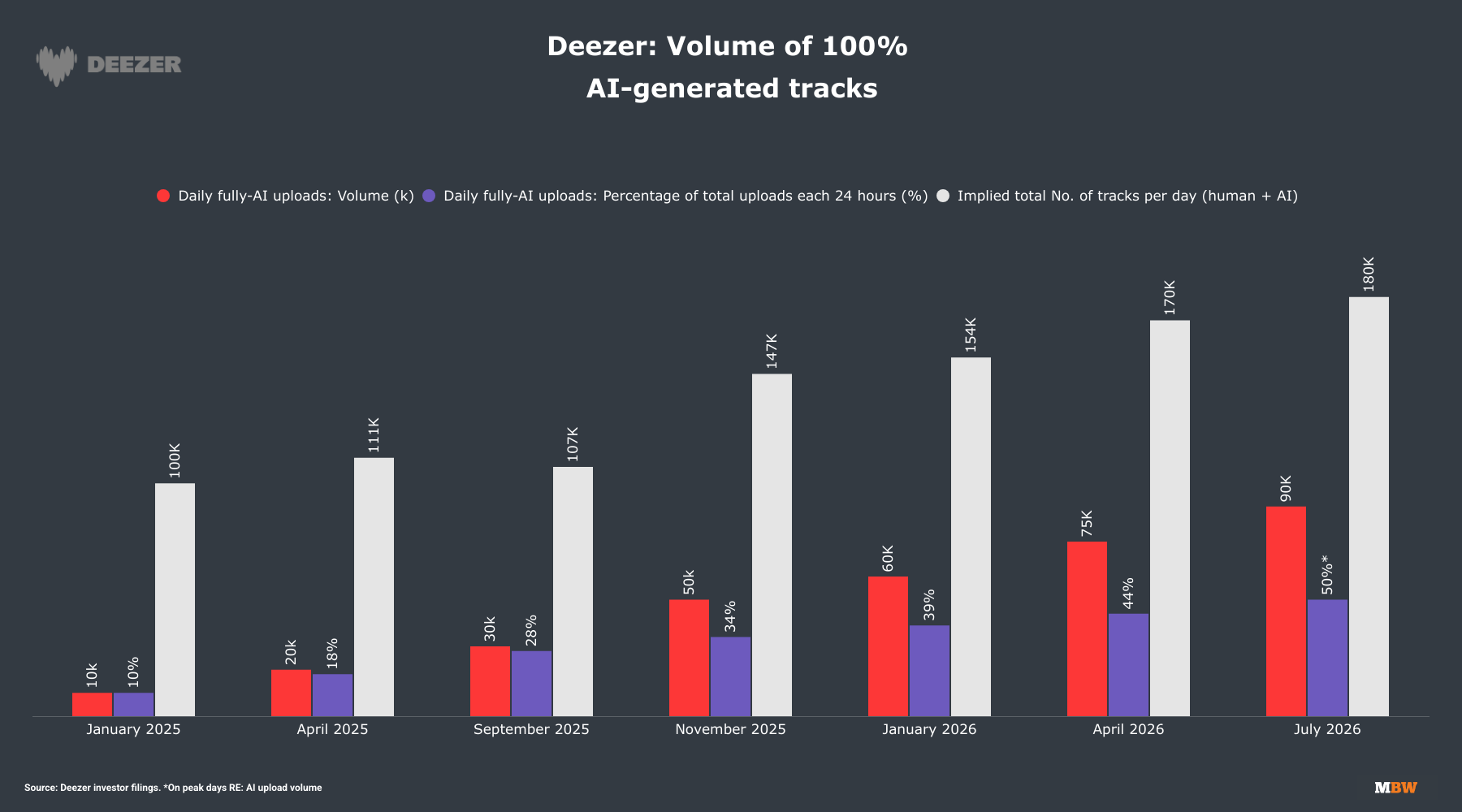
Deezer is receiving nearly 90,000 fully AI-generated tracks every day. On peak days, that adds up to more than 50% of all new music delivered to the platform, according to the company.
Now the Paris-headquartered streaming service is giving users a way to switch that music off.
Deezer said on Tuesday (October 13) that it will introduce an on/off toggle letting users exclude fully AI-generated music from their search results.
It will roll out globally before the end of 2026.
Here’s everything you need to know…
What the toggle does
Deezer already strips tracks it detects as fully AI-generated out of its algorithmic recommendations and keeps them off its editorial playlists.
The toggle extends that exclusion to Deezer‘s search results, if the user chooses.
Once a user activates it, search will omit fully AI-generated tracks, albums, and “the related artists,” according to Deezer.
The company has also been tightening its own rules. Since April, it has stopped storing hi-res versions of AI-generated tracks, and in July it said it would take down those used to inflate streams fraudulently, as well as those that have not been streamed for six months or more.
“The explosion of AI-generated content continues to impact the whole music ecosystem, and we believe in shaping a future based on transparency and choice, with respect for artists, songwriters and music fans,” said Alexis Lanternier, CEO of Deezer. “We remain committed to minimizing any negative effects, while empowering our users to control their music experience to the greatest extent.
“We’ve seen a clear user demand for the ability to filter out AI-generated music, and we are now giving everyone the option to remove this content completely from their streaming experience on Deezer, and focus only on human creators and creations, if they wish.”
The evidence the company cites for that demand is a survey of 9,000 people in eight countries, commissioned from Ipsos in November 2025, which found that 45% of music streaming users “would like to filter out 100% AI-generated music” from their platform.
Deezer has not said how many of its own users it expects to switch the toggle on.
How big is the problem?
When Deezer launched its detection tool in January 2025, it was receiving roughly 10,000 fully AI-generated tracks a day – about 10% of daily deliveries.
The figure passed 20,000 by April 2025, then reached 30,000 in September, 50,000 in November, and 60,000 in January 2026, or 39% of deliveries.
In April 2026, Deezer reported nearly 75,000 a day, or more than 44%.
Then, in July, it said the figure had reached nearly 90,000 a day in June – a ninefold increase in around 17 months.
Follow the money
On Deezer, that volume has barely translated into listening.
Fully AI-generated tracks now account for only 1% to 3% of streams on the platform, up from 0.5% in June 2025, according to the company.
And Deezer says up to 85% of the streams those tracks generated in 2025 were fraudulent.
Deezer says “it’s evident that the primary purpose of uploading these tracks to streaming platforms is fraudulent,” and that it strips manipulated streams out of royalty payments.
The incentive lies in the pro-rata model used by services such as Spotify, under which each track’s payout depends on its share of all streams in a given period.
That model was central to the case against Michael Smith, who prosecutors said used fake accounts to stream hundreds of thousands of AI-generated songs billions of times.
US District Judge John G. Koeltl sentenced Smith to 18 months in prison on October 6.
In an October 2018 email quoted by prosecutors, Smith wrote: “in order to not raise any issues with the powers that be we need a TON of content with small amounts of Streams.”
The Music Fights Fraud Alliance told the court that “[e]very fraudulent stream perpetrated by Mr. Smith diluted the value of every legitimate stream occurring during the same accounting period.”
Spreading streams as thinly as Smith described is now harder to monetize on Spotify, which since April 2024 has paid recording royalties only on tracks with at least 1,000 streams in the previous 12 months.
The math also differs in France, where Deezer launched an artist-centric payout model with Universal Music Group in 2023, with other markets promised to follow.
Under that model, streams of artists with at least 1,000 monthly plays from 500 unique listeners count double – which shrinks, but does not remove, what a low-stream catalog can draw from the pool.
What if Deezer gets it wrong?
The toggle also raises the cost of a detection error for human artists.
Deezer‘s creator help page currently tells artists that tagged music can still be found “through direct searches and your artist page.”
For listeners who activate the toggle, search will no longer be one of those routes.
Under the July takedown policy, a human-made track wrongly tagged as AI that goes six months without a stream could be in line for removal, not just hidden. The same help page, dated March 2026, still tells artists that tagged music will remain on the platform.
Deezer applies its AI label at album level, to any album containing detected AI-generated music.
The October 13 announcement does not define “the related artists” – or say whether an artist with both tagged and untagged releases would vanish from search, or only the tagged albums.
The definition of “fully” matters too, and Deezer‘s wording is not uniform.
Deezer‘s help page defines AI-generated content as music “fully created by AI music generation tools, rather than traditional human composition and production.”
Yet the same page also lists content that uses AI tools or contains significant AI-generated elements among the triggers for tagging, while saying the system mainly targets fully AI-generated tracks.
Tagging happens automatically at upload, and artists cannot opt out, according to Deezer.
Artists who believe they have been wrongly tagged must appeal through their distributor, which escalates the case to Deezer for manual review.
If the distributor does not respond within five business days, artists can go to the company directly.
Deezer has not published how many appeals it receives, or how many succeed.
Deezer puts its tool’s accuracy at 99.8%, saying it may miss about two AI-generated tracks in every 1,000 and wrongly flag fewer than one human-made track in every 10,000.
Applied to the April 2026 delivery figures, that error rate implies fewer than 10 human-made tracks wrongly flagged a day, or as many as roughly 3,500 a year, by MBW‘s calculation. And because the label attaches at album level, each of those tracks would put its whole album under the AI tag.
The accuracy figures are Deezer‘s own, and the company has not said whether they have been independently audited.
A 99.8% figure also appears in a paper published in January 2025 by three Deezer researchers, describing accuracy on a test dataset.
The authors cautioned that “getting a good test score is not the end of the story,” citing audio manipulation and generative models a detector has not been trained on. Their code repository also notes that the tool it contains is not the one Deezer uses in production.
The company names Suno, Udio, and Riffusion among the generators it can detect.
How the rest of the industry sees it
YouTube Music began labeling songs made “primarily using generative AI” on Wednesday (October 14), using its own detection tools alongside information from music partners.
TIDAL said in June that it would tag fully AI-generated music and pay no royalties on it.
Fellow French service Qobuz said in February that it would tag AI-generated content using its own detection tool.
Apple Music told industry partners in August that its AI Transparency Tags, which depend on labels and distributors declaring AI content, would become visible to listeners as “Made With AI” labels later this year.
Spotify, which shows AI credits where labels and distributors disclose them, said in September 2025 that the industry should not “be forced to classify every song as either ‘is AI’ or ‘not AI.'”
In August, however, it said it would label artist profiles with AI-generated identities “AI Persona,” including through its own reviews, and keep their music out of editorial and algorithmic recommendations by default. The badge concerns who is behind a profile, not how the music was made.
Writing in October 2025, Water & Music‘s Cherie Hu said Deezer had taken “the most aggressive stance against AI of all the major DSPs.”
Hu argued that pulling detected tracks from recommendations amounts to a judgment that music made mainly with generative AI deserves less exposure.
Hu also wrote that audio detectors can be thrown off by routine edits such as resampling or pitch shifts.
The toggle lets each listener make a call Deezer has so far made only for fraud-linked and unplayed tracks: whether this music should be there at all.
How many listeners turn it on, and how many human artists are caught by it, are the numbers Deezer has yet to publish.