MBW Explains is a series in which we dig behind the headlines, via data and context, to improve your understanding of key stories. Only MBW+ subscribers have unlimited access to these articles. MBW Explains is supported by Reservoir.
Despite assertions from the White House, President Donald Trump’s plan to keep TikTok running in the US is not a done deal just yet.
And even if it were, there’s still plenty we don’t know about what the new TikTok US will look like, and who will control what when it comes to one of the most influential social media apps in the world.
Having announced in mid-September that he had reached an agreement with China on the framework for a deal to see ByteDance-owned TikTok’s US operations transferred to the control of US owners, Trump on Thursday (September 25) signed an executive order establishing a roadmap for the “qualified divestiture” of TikTok’s US operations to American hands.
That’s a requirement of the law passed by a large bipartisan majority in Congress last year and signed by then-President Joe Biden, which requires TikTok to stop operating in the US unless its US operations are sold off from its Chinese parent company.
The president also delayed TikTok’s deadline to sell its US operations for a fourth time, to December 16, and ordered the Department of Justice not to enforce the divest-or-ban law until January 23, 2026, in order to give time for the deal to be finalized.
“I told [Xi] what we were doing [with TikTok] and he said go ahead with it.”
President Donald Trump
In recent weeks, details of the deal have been making their way into the media, primarily through unnamed sources. As those details emerge, the Chinese government and ByteDance have remained noticeably tight-lipped about the whole thing.
Trump insists the deal has the backing of Chinese President Xi Jinping. “I told him what we were doing and he said go ahead with it,” he told reporters last week.
Yet there’s been no news that the Chinese government has changed the law that forbids certain sensitive technologies to be exported – in this case, TikTok’s powerful recommendation algorithm, credited with making the app a success for the businesses that advertise and sell on the platform.
And there may be work to do on the US side of things: some of the details that have come out about the deal have raised questions about whether Trump’s deal will satisfy the demands of the divest-or-ban law.
The fate of TikTok in the US could have a significant impact on the music industry, as TikTok has become a major source of music discovery over the past decade. TikTok has often highlighted the link between virality on its platform and success on the record charts.
Here are five crucial things to know about Trump’s deal for TikTok US:
Photo credit: drserg / Shutterstock.com1) Allies of Trump and a Middle East investment fund will be among the new owners
The core of Trump’s deal revolves around the establishment of a new joint venture that will own TikTok in the US. Per news reports, TikTok parent ByteDance will own just under 20% of this new company, while the remaining 80% will be held by new investors and existing (non-Chinese) investors in ByteDance.
The key investors will be Texas-headquartered tech firm Oracle Corp., which already has a relationship with TikTok US as a data services provider; private equity firm Silver Lake; and MGX, an AI investment firm owned by the United Arab Emirates.
According to the Washington Post, each of the three will own a 15% stake in TikTok US. The remaining 35% will be in the hands of other investors, including existing US-based investors in ByteDance, among them PE firm General Atlantic, trading and tech firm Susquehanna and venture capital firms Sequoia and Andreessen Horowitz, all of whom are expected to contribute equity in the new joint venture.
Others identified by Trump or the White House as potential investors include conservative media mogul Rupert Murdoch and his son Lachlan, via Fox Corp., along with Michael Dell of Dell computer fame.
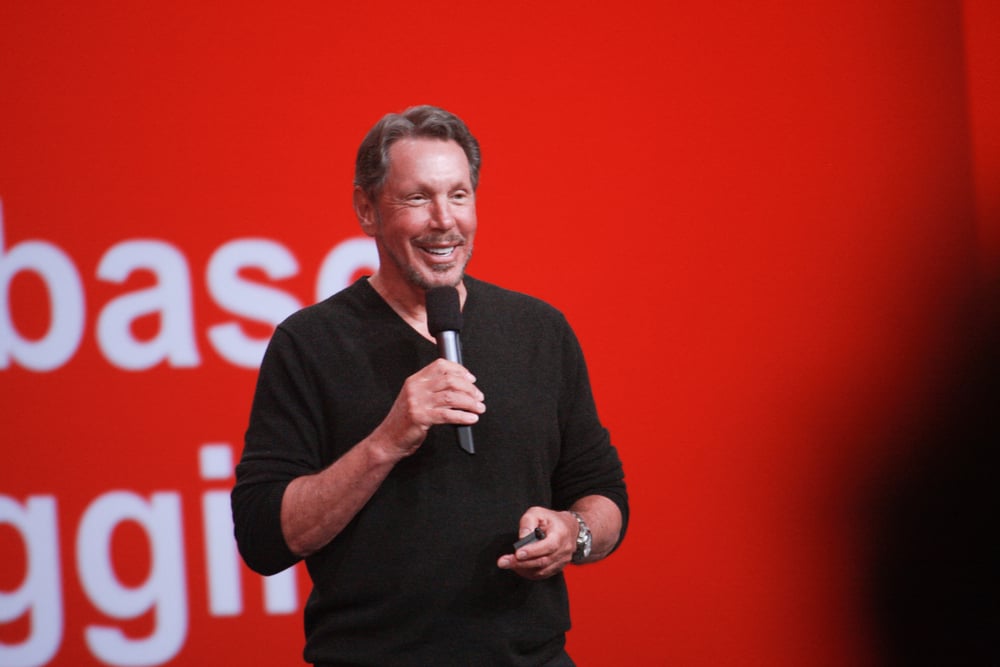
Oracle’s co-founder and board chairman, Larry Ellison (pictured inset), is a noted long-time political supporter of Donald Trump known to have held fundraisers for Trump. (Ellison briefly topped a Trump ally (or former ally), Elon Musk, as the world’s richest person earlier this year.)
And Oracle’s existing involvement with TikTok was the result of Trump’s previous attempt to ban TikTok during his first term in office, a move that was blocked by the courts but resulted in TikTok hiring Oracle to manage the data of its US users.
Even before the TikTok stake, Ellison was well on his way to becoming a major media mogul. Via his son David, the Ellison family has a 26% stake in Skydance Corporation, the new company formed by the merger of Skydance Media and Paramount Global, which includes CBS.
2) A state-owned Middle Eastern investment fund that has done business with Trump will reportedly be a stakeholder
Among the investors tipped to take over TikTok in the US, one name stands out for not being a US-based entity, and for being a state-owned enterprise.
MGX Fund Management Limited is owned by the government of the United Arab Emirates and is known for its investments in tech and AI. The company’s board chair is Sheikh Tahnoon bin Zayed Al Nahyan, the UAE’s national security advisor and brother of President Mohamed bin Zayed Al Nahyan.
MGX is also known for a recent investment that lifted the profile of a Trump-owned business. Earlier this year, it was announced that MGX was making a $2 billion minority investment into cryptocurrency exchange Binance, and it would make the investment using the USD1 stablecoin, a cryptocurrency tied to the value of the US dollar.
This intricate web of connections between Trump and TikTok’s new investors has prompted some to complain of “crony capitalism“.
“By steering TikTok to allies like Larry Ellison and a fund backed by the United Arab Emirates… Trump is rapidly consolidating control over the major digital and broadcast media companies while he attacks the First Amendment at every level,” said Sen. Ron Wyden, an Oregon Democrat.
Credit: Chutima Chaochaiya/Shutterstock3) At $14 billion, TikTok US’s valuation is strangely low – but there might be a reason for that
One of the aspects of the TikTok deal that has raised the most eyebrows is the valuation of TikTok US: $14 billion, according to Vice President JD Vance.
That’s way below what analysts have estimated that TikTok US is worth. A Wedbush Securities analyst cited by Reuters said TikTok was valued at $30 billion to $40 billion, without the algorithm, earlier this year.
The apparent selling price is lower than a year’s worth of TikTok sales in the US, which the Financial Timesreported was $16 billion in 2023. And, significantly, it’s lower than the $20 billion a consortium of US investors said earlier this year they would be willing to pay for TikTok US.
That could make this “the most undervalued tech acquisition of the decade,” Ashwin Binwani of Alpha Binwani Capitaltold Bloomberg.
However, there might be a reason why the investors in the new TikTok US joint venture are paying such a low price: They might have to share a great deal of profit with ByteDance…
4) ByteDance will still have a great deal of control of TikTok US – and could get 50% of its profit, according to reports
A recent report from Bloomberg News sheds some light on why investors might not be willing to shell out the full market price for TikTok US: They may not get a commensurate share of the profits.
According to sources who spoke to Bloomberg, ByteDance will charge a licensing fee for the use of its recommendation algorithm that will amount to 20% of “incremental revenue, or revenue generated by the algorithm.”
On top of that, it would be entitled to its share of the profits as a shareholder with just under 20% of the company.
In total, Bloomberg estimates that ByteDance will take “50% or more of the overall profit of the US operation.”
And that might not be the full extent of ByteDance’s involvement in TikTok US. According to a report at Reuters, citing three unnamed sources, ByteDance will continue to own TikTok’s US business operations under the Trump deal, but will hand over control of the app’s data, content and algorithm to the joint venture.
If, indeed, these investors aren’t buying TikTok’s US business operations, but only the app’s data and content, along with control of an algorithm for which they have to pay a licensing fee, that could certainly explain the low valuation of the TikTok US joint venture.
This arrangement, if confirmed, also raises questions as to whether the deal even meets the standard for a “qualified divestiture” under the divest-or-ban law.
Republican House Rep. John Moolenaar, who chairs the House Select Committee on China, told Reuters that the deal should “preclude operational ties between the new entity and ByteDance.”
“The law also set firm guardrails that prohibit cooperation between ByteDance and any prospective TikTok successor on the all-important recommendation algorithm,” Moolenaar said.
Reuters’ sources noted that talks over TikTok are still ongoing, and the structure of the deal could yet change.
Photo credit: Piotr Swat / Shutterstock.com5) Oracle will control the US algorithm – and will have to run it by the government
Once TikTok US is up and running, control of the recommendation algorithm will fall to Oracle, which the company would then retrain “from the ground up,” a White House spokesperson told the media on September 22.
Data from US users will be stored in a secure cloud, and that data will not be shared with ByteDance, the spokesperson said.
Also, Oracle will “operate in partnership” with the US government on changes to the algorithm, app development, and source code review, the White House official said.
Amid all the controversy in recent years (on both sides of the political aisle) over the US government’s interference with media, this seemingly unprecedented move to have Washington oversee a social media algorithm could raise some questions about the independence of media.
While it’s difficult to predict, at this point in time, just how these changes will affect music discovery on TikTok, there is one concern out there that could prove relevant.
Oracle will be retraining the TikTok algorithm only on US user data (it’s a given that ByteDance won’t be sharing TikTok user data from outside the US with Oracle). That means TikTok US’s algorithm will be trained on a far smaller data set than the global TikTok algorithm. TikTok has about 170 million users in the US, amounting to little more than a tenth of its 1.6 billion global users.
That could mean the algorithm could decline in quality in the US, as its coders would have a far smaller sample size to analyze. It could also mean the US algorithm would miss many major global trends, potentially reducing the exposure of non-US artists in the US market, and creating a larger cultural gap between US and global TikTok users.
For the music industry and other businesses that’ve come to rely on TikTok, it might become necessary to have two separate TikTok strategies in order to satisfy the demands of the algorithm – one for the US and another for the rest of the world.
All of which means those who’ve come to rely on TikTok should keep a close eye on how this deal shakes out in the real world – if, indeed, it even comes to fruition.
Reservoir (Nasdaq: RSVR) is a publicly traded, global independent music company with operations across music publishing, recorded music, and artist management.Music Business Worldwide