Warner Music Group just posted record revenues for its latest fiscal year.
Across its fiscal 2026 (the 12 months to September 30), Warner’s revenues grew 8.9% YoY at constant currency to USD $7.437 billion.
The firm’s most-watched metric – recorded music subscription streaming revenues – was up 12.4% YoY at constant currency to $3.017 billion in the year-long period.
Warner also told investors that money from its AI licensing deals is on its way.
“We will see material revenue contribution in fiscal ’27.”
Robert Kyncl on WMG’s Suno income
On the company’s earnings call last week (November 19), acting CFO Lou Dickler said: “I’ll just remind everyone that Q4 did not include any meaningful contribution from AI revenue. We expect that to start flowing through in Q1.”
That’s fiscal Q1, or calendar Q4 (i.e., the quarter in which you’re reading these words).
Warner struck a licensing deal with Suno in November 2025. We’ll soon start to see what that deal – and Warner’s other AI partnerships – is actually worth.
Asked by an analyst last week about the revenue Warner expects from Suno, WMG CEO Robert Kyncl reiterated: “[We] will see material revenue contribution in fiscal ’27.”
In addition to publishing its Q4 and full-year results, Warner filed its annual report (10-K) with the SEC on the same day – a treasure trove of information for snoops like MBW.
Here are five things I noticed/calculated while flicking through it…
1) YouTube paid Warner over $1 billion in fiscal 2026
By MBW’s estimate, YouTube paid Warner Music Group more than USD $1 billion in WMG’s latest fiscal year – the first time the platform’s annual contribution to WMG has crossed that threshold.
Each year, Warner’s 10-K names any customer that individually accounts for 10% or more of the company’s total revenues, and discloses the share each one supplies.
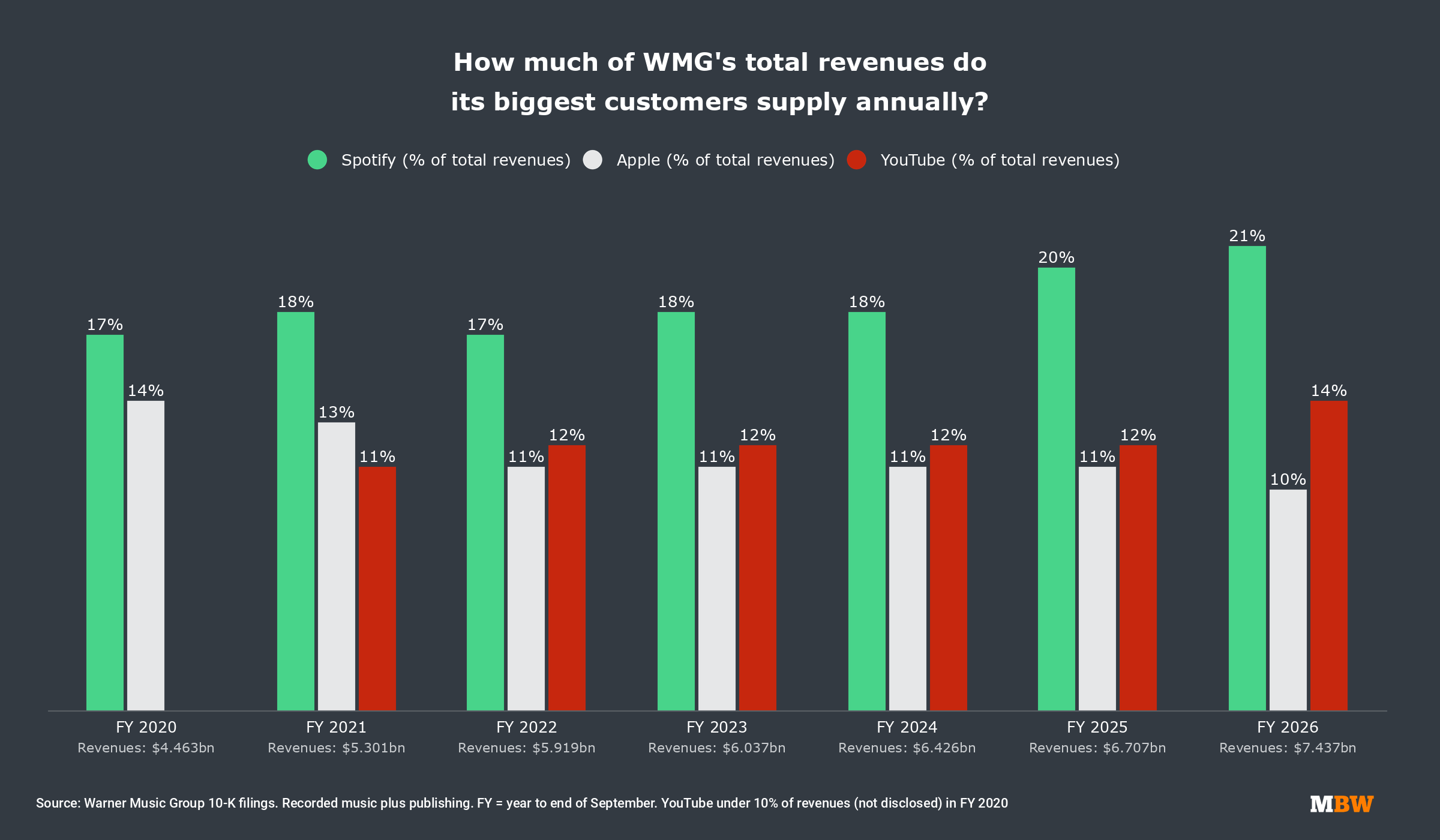
This year’s 10-K states: “In the fiscal year ended September 30, 2026, the Company had three customers, Spotify, YouTube and Apple, that individually represented 10% or more of total revenues, whereby Spotify AB represented 21%, YouTube represented 14% and Apple represented 10% of total revenues.”
Warner’s total revenues in fiscal 2026 were $7.437 billion. And 14% of that figure (i.e., YouTube’s contribution) is approximately $1.04 billion.
(Warner rounds these percentages to the nearest whole number. But even if YouTube’s true share were at the bottom of that rounding range, 13.5%, its contribution would still come to just over $1 billion.)
A year earlier, YouTube accounted for 12% of Warner’s $6.707 billion in revenues – approximately $805 million.
On MBW’s estimates, YouTube’s contribution to Warner grew by around 29% YoY in fiscal 2026.
That’s faster in percentage terms than Spotify, whose contribution to Warner grew by around 16% YoY in fiscal 2026 to approximately $1.56 billion (21% of total revenues), and Apple, whose contribution was broadly flat at approximately $744 million (10%).
By the same estimates, YouTube now generates around $300 million more a year for Warner than Apple does; Spotify is contributing around double its Cupertino rival.
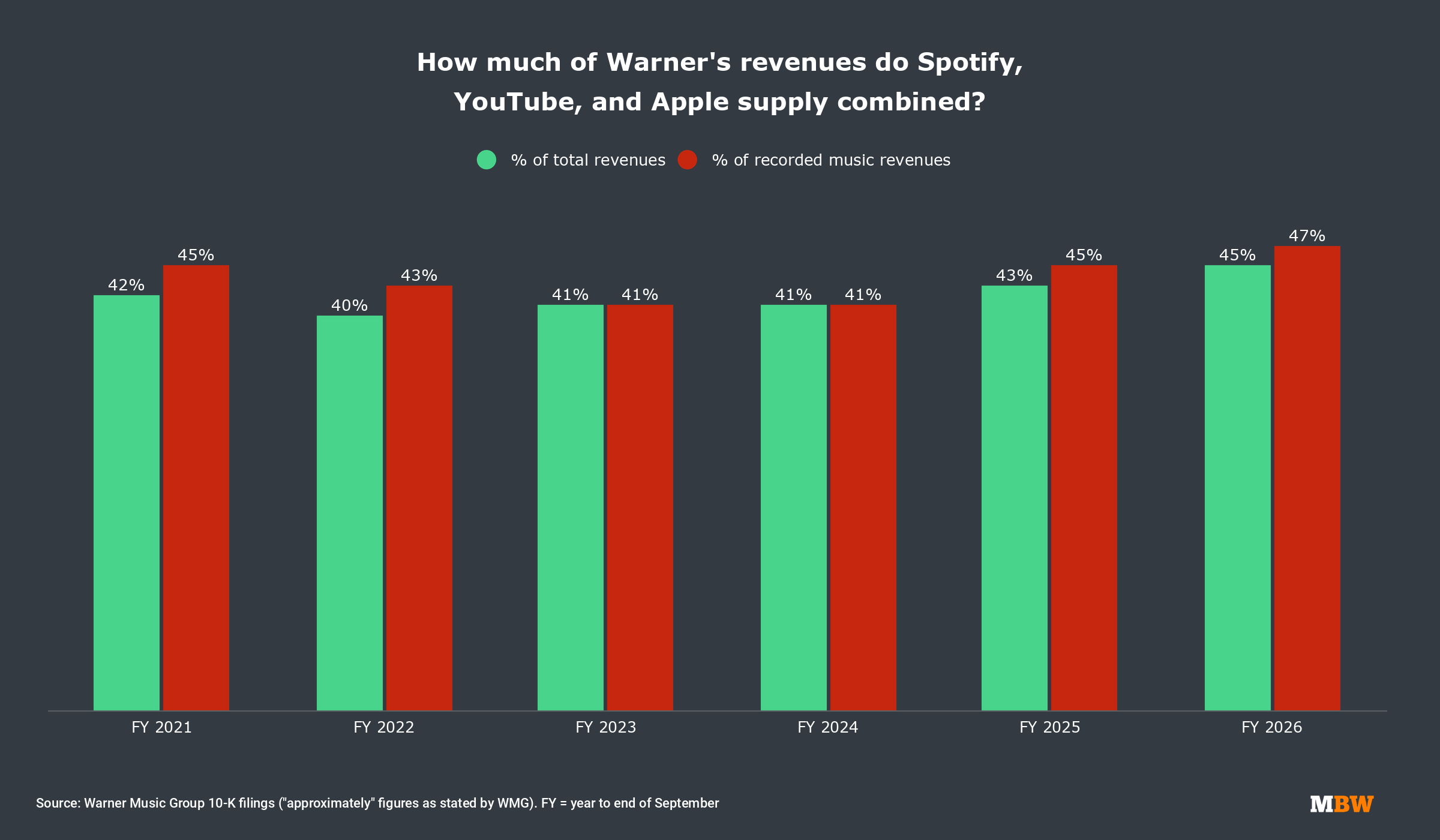
It’s also worth noting that Warner’s revenue sources have become increasingly concentrated in recent years.
In fiscal 2026, Spotify, YouTube, and Apple jointly accounted for approximately 45% of WMG’s total revenue.
That’s the highest combined share Warner has disclosed for the three platforms since YouTube first passed the 10% threshold in fiscal 2021. The figure was 42% in fiscal 2021, 40% in fiscal 2022, 41% in both fiscal 2023 and fiscal 2024, and 43% in fiscal 2025.
As a share of Warner’s Recorded Music revenues, Spotify, YouTube, and Apple accounted for approximately 47% in fiscal 2026, according to the 10-K, up from 45% a year earlier.
2) As expected, WMG’s headcount fell last year
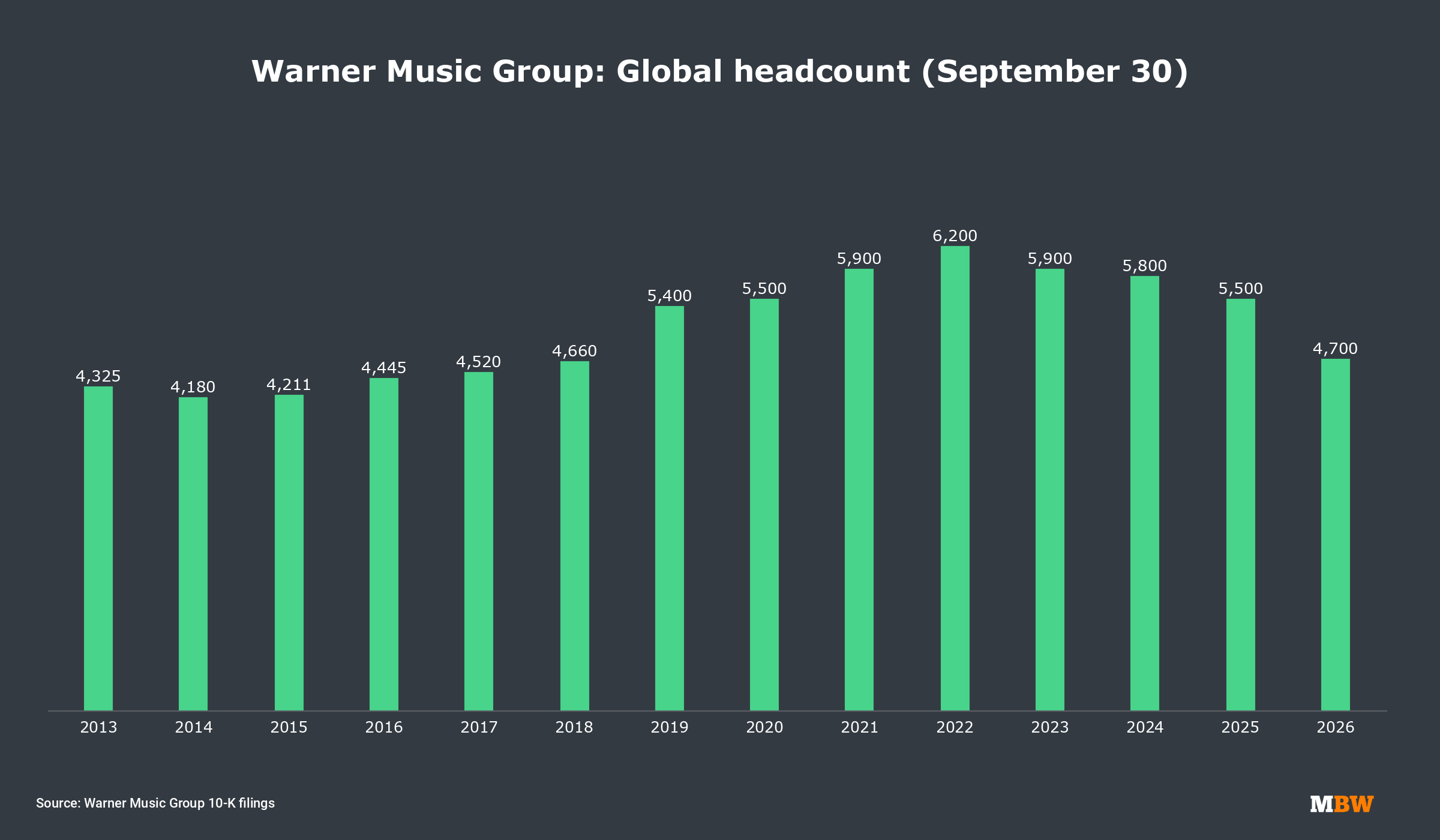
Warner employed approximately 4,700 people worldwide as of September 30, 2026, according to its 10-K. A year earlier, the equivalent figure was approximately 5,500.
That’s a drop of around 800 people, or roughly 15%, in 12 months. It’s also Warner’s lowest end-of-fiscal-year headcount since 2018, when the company employed 4,660 people.
Warner’s headcount now sits around 1,500 below the approximately 6,200 it employed at the end of September 2022, three months before Kyncl took over as CEO on January 1, 2023.
Over the same period, Warner’s annual revenues have grown from $5.919 billion (fiscal 2022) to $7.437 billion (fiscal 2026).
Divide revenues by headcount, and Warner generated approximately $1.58 million of revenue per employee in fiscal 2026, up from approximately $955,000 in fiscal 2022.
The headcount fall follows three rounds of cuts announced under Kyncl.
- The first, in March 2023, involved around 270 roles, or approximately 4% of Warner’s workforce at the time.
- The second, announced in February 2024, initially involved around 600 roles, or approximately 10% of the workforce. Warner raised that figure to around 750 roles (approximately 13%) in September 2024.
- The third, announced in July 2025, set out to reduce Warner’s annual costs by around $300 million, with around $170 million of those savings to come from headcount reductions.
Part of the YoY drop in headcount could reflect Warner’s sale of EMP, the German merch business it acquired in 2018, which completed in Warner’s fiscal fourth quarter.
Kyncl told analysts on last week’s call: “On [WMG’s] efficiency, it really is simple: I made some really tough decisions, and it’s moved us from being a holding company mindset to an operating company mindset.
“We were previously set up for a physical business, and we strategically realigned it for the digital world.”
3) Yes, Warner really is spending more on A&R
When Kyncl announced Warner’s February 2024 round of cuts, he told staff: “The majority of these savings will be reinvested, putting more money behind the music.”
Has that happened? In a word: yes.
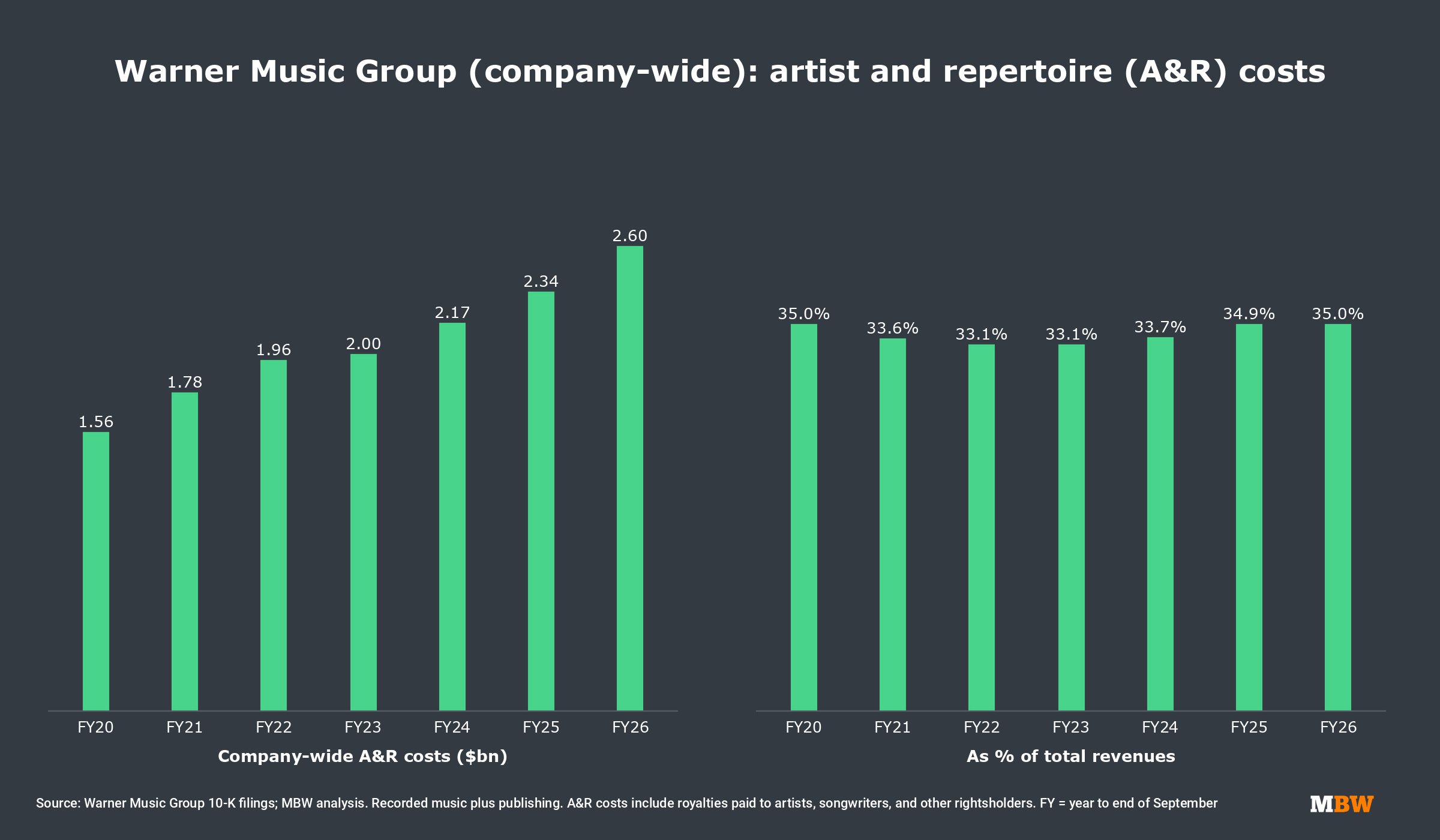
Warner’s artist and repertoire (A&R) costs rose 11% YoY in fiscal 2026 to $2.600 billion, according to the 10-K. In fiscal 2023, the equivalent figure was $1.998 billion.
That’s an increase of approximately $602 million (+30%) in Warner’s annual A&R costs across three years.
Warner’s definition of A&R costs includes royalty payments, so the figure naturally moves partly in line with revenues. The 10-K specifically describes A&R costs as “the costs associated with (i) paying royalties to recording artists, producers, songwriters, other copyright holders and trade unions; (ii) signing and developing recording artists; and (iii) creating master recordings in the studio”.
Measured as a share of Warner’s total revenues (i.e., including recorded music plus publishing), A&R costs have risen from 33.1% in fiscal 2023, to 33.7% in fiscal 2024, to 34.9% in fiscal 2025, to 35.0% in fiscal 2026.
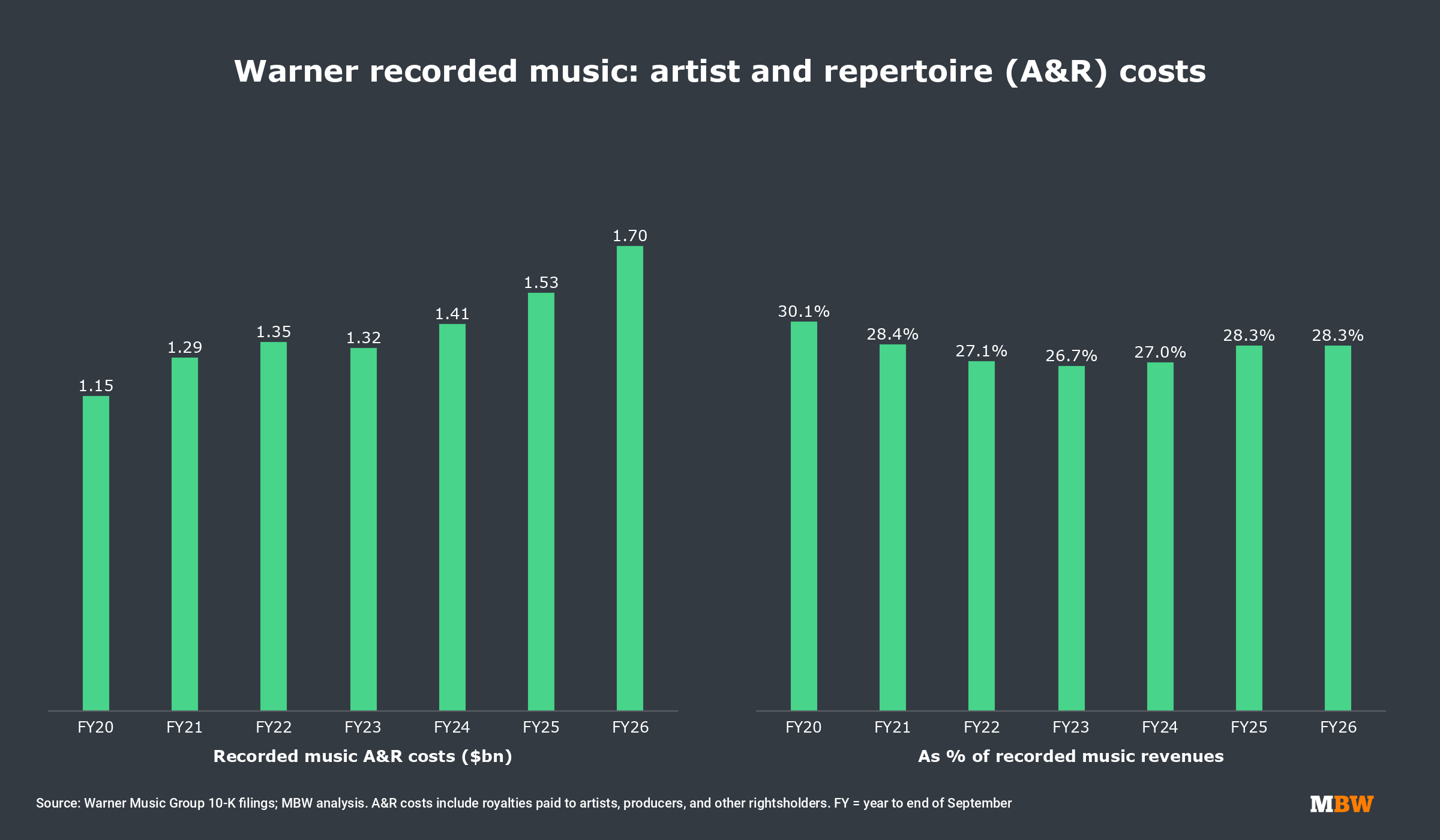
In recorded music specifically, Warner’s A&R costs rose 11% YoY to $1.697 billion in fiscal 2026, up from $1.323 billion in fiscal 2023.
As a share of recorded music revenues, those costs were 28.3% in fiscal 2026 – up from 26.7% in fiscal 2023, but below the 30.1% recorded in fiscal 2020.
4) The US now generates just 40% of Warner’s recorded music revenues
Warner’s recorded music business generated $2.408 billion in the US in fiscal 2026, and $3.579 billion internationally.
That means the US accounted for 40.2% of Warner’s recorded music revenues in the year – the lowest share since fiscal 2015 (39.2%), according to Warner’s annual filings.
First, a definition. Warner’s 10-K presents these figures as “revenues relating to operations in different geographical areas”.
In practice, that makes this broadly a split by market of consumption – not by where an artist is signed. So when, say, a US-signed Atlantic act is streamed in Germany, that money will typically count as international revenue.
(Warner’s foreign affiliates do remit royalty payments to its US affiliates, but those intra-group payments are stripped out of the consolidated figures discussed here.)
Warner itself puts it plainly in its 10-K: over half of its annual recorded music revenues “are generated outside of the United States”.
And in recent years, international has been pulling away from the US.
The US share of Warner’s recorded music revenues fell from 44.9% in fiscal 2022 to 40.3% in fiscal 2025.
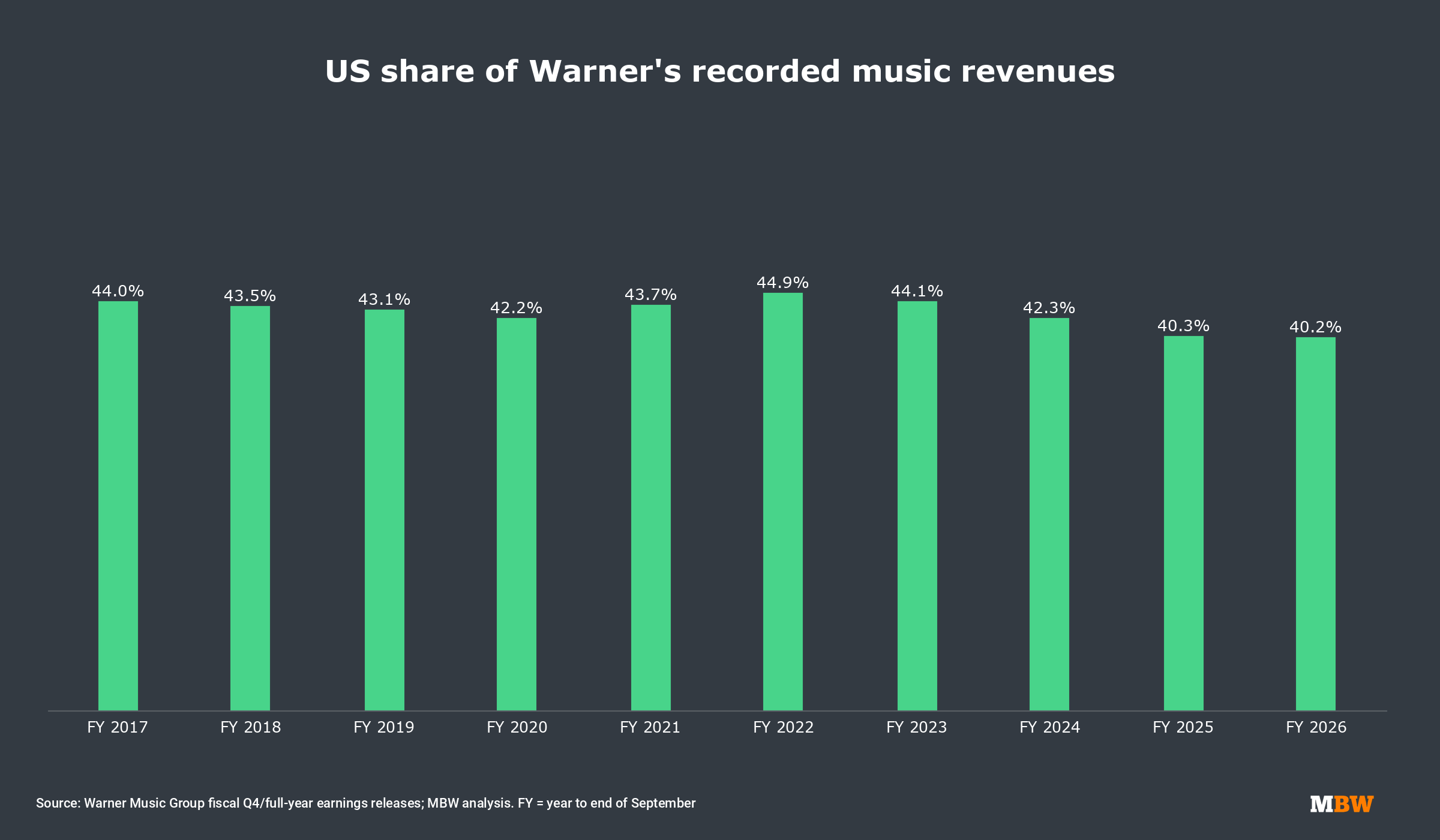
That trend stalled in fiscal 2026, when the US share held almost level, at 40.2%. (At constant currency, Warner’s US recorded music revenues actually grew faster than its international recorded music revenues: 10.4% YoY, versus 7.6% YoY.)
But pull back over a four-year period – one that spans Kyncl’s tenure as CEO – and the bigger story becomes clearer.
Between fiscal 2022 and fiscal 2026, Warner’s US recorded music revenues grew 7.9%, or $177 million, from $2.231 billion to $2.408 billion.
Over the same period, its international recorded music revenues grew 30.9%, or $844 million, from $2.735 billion to $3.579 billion.
That means international markets accounted for around 83% of Warner’s recorded music revenue growth in the fiscal 2022–2026 period.

5) Warner’s JV with Bain has bought $233 million of assets… from Warner Music Group
Warner and Bain Capital launched Beethoven JV 1, LLC – a 50/50 joint venture set up to acquire music rights – in July 2025.
In February this year, the two partners increased their equity commitments to the JV by $100 million each, taking its total spending power to $1.65 billion.
The JV’s acquisitions include the Red Hot Chili Peppers’ recorded music catalog, which was reported in May to have been sold to WMG/Bain for over $300 million.
Warner’s new 10-K details another set of transactions.
The filing states: “In the second quarter of fiscal year 2026, [WMG] sold recorded music catalog rights to Beethoven for consideration of $233 million, receiving $182 million of cash in return, net of the Company’s portion of contributions to the joint venture for the acquisition.”
In other words, a JV in which WMG owns 50% spent over $200 million buying recorded music catalog rights from… WMG itself.
Warner’s fiscal second quarter ran from January to March 2026.
“[WMG] sold recorded music catalog rights to Beethoven for consideration of $233 million.”
Warner’s 10-K
The filing doesn’t mention the recordings that Warner sold to the JV, or the artists involved.
It does, however, describe what Warner sold as “recorded music catalog rights” – not catalogs. And Warner’s Q2 earnings release flagged a “taxable gain” on its contribution to the JV, suggesting these were long-held assets at WMG.
Interestingly, Bain gets paid first if the Beethoven JV is sold or floated.
The 10-K confirms: “If we sell existing catalogs owned by [WMG] to the joint venture, we will only own 50% of those catalogs and in a liquidity event, WMBC [Beethoven] will need to pay a preferred return to Bain before we receive any return on our investment, which may reduce our future earnings or cash flows.”
The 10-K also specifies the size of that preferred return. In a liquidity event, such as a sale or IPO of the JV, Bain “is entitled to proceeds from such event until its contributed capital is returned with an annualized return of 8%, subject to certain adjustments, after which the Company will receive distributions for an equal amount, with any additional amounts distributed equally”.
Bain has an exit right “beginning on the sixth anniversary of formation” of the JV. Warner has a similar exit right beginning on the eighth anniversary.Music Business Worldwide