MBW Reacts is a series of analytical commentaries from Music Business Worldwide written in response to major recent entertainment events or news stories. Only MBW+ subscribers have unlimited access to these articles.
The IFPI Global Music Report 2026 reveals a music industry that accelerated its growth in 2025 — and surpassed USD $30 billion in annual recorded music revenues for the first time.
To be clear: the IFPI’s numbers refer strictly to wholesale recorded music revenues (i.e. the money paid through to labels, distributors, and artists).
The worldwide numbers contain plenty of good news for rightsholders (see: a return to growth for physical formats, double-digit gains in four regions, and China crashing into the global Top 4), but also some signals worth watching (see: the maturation of the North American market, and streaming fraud emerging as a key industry talking point).
Here are 10 quick takeaways from the report (the full version is available here).
1. Growth accelerated — and revenues surpassed $30 billion for the first time
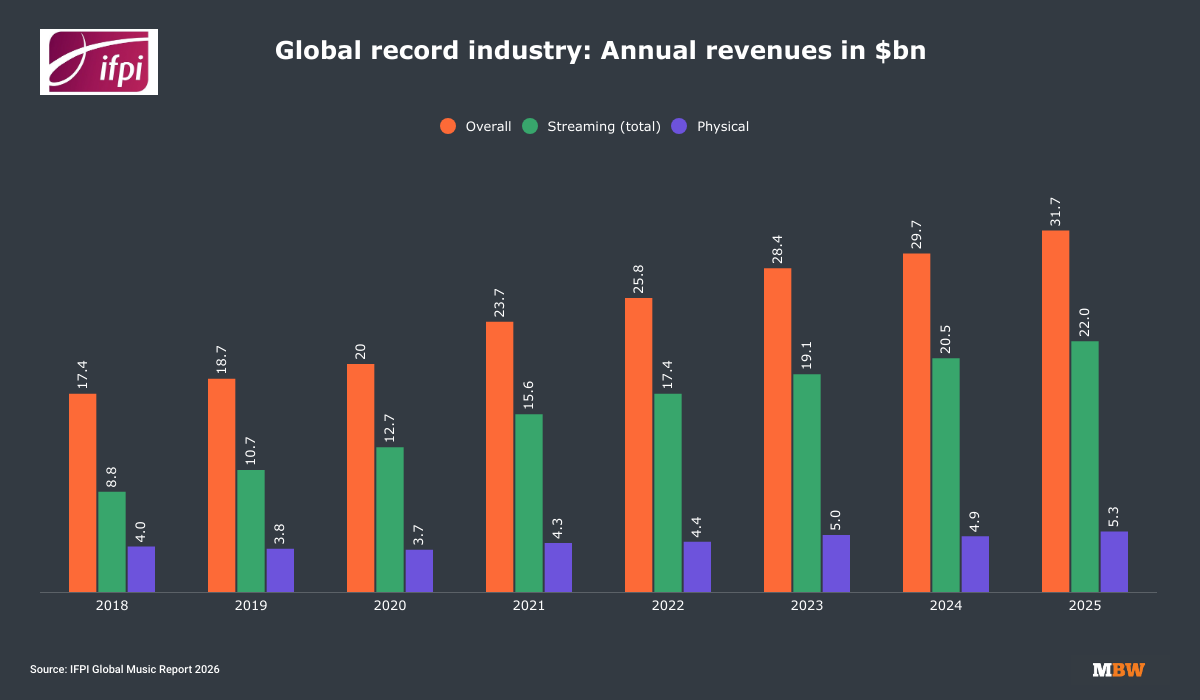
Global recorded music revenues grew 6.4% YoYin 2025, reaching USD $31.7 billion — the eleventh consecutive year of growth.
Notably, the rate of growth accelerated compared to the prior year. The IFPI previously reported that the global industry grew by 4.7% YoYin 2024, meaning the percentage growth of the business improved markedly in 2025.
This also marks the first time that global recorded music revenues have surpassed USD $30 billion — a symbolic milestone that underlines how far the industry has come since its nadir of USD $13.1 billion in 2014.
This chart has been updated to reflect adjusted retrospective annual figures from IFPI’s GMR 2026
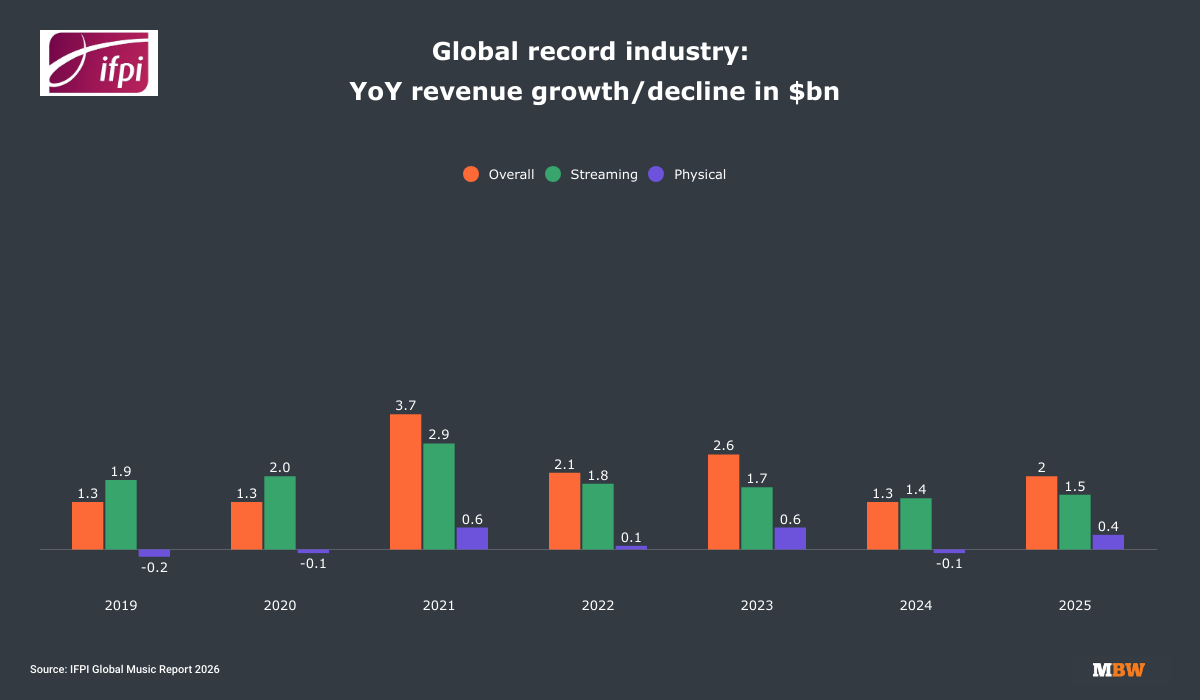
As the below chart shows, the global industry added USD $2.0 billion in revenue in 2025 — the second-largest single-year addition since 2019, behind only 2023’s USD $2.6 billion annual gain.
This chart has been updated to reflect adjusted retrospective annual figures from IFPI’s GMR 2026
Credit: miss.cabul / Shutterstock.com2. Paid subscription streaming continues to drive the business
Paid subscription streaming revenues increased 8.8% YoY in 2025, and accounted for more than half — 52.4% — of global revenues.
Total streaming revenues (including both paid subscription and advertising-supported) surpassed USD $22 billion for the first time in 2025, and accounted for 69.6% of total recorded music revenues.
Total streaming grew by 7.7% YoY overall, with subscription streaming (+8.8% YoY) comfortably outpacing ad-supported formats (+4.3% YoY).
Credit: Przemek Klos/Shutterstock3. Physical formats returned to growth — and outpaced digital
Physical music trade revenues grew by 8.0% YoYin 2025, a significant rebound from the -3.0% decline posted in 2024.
Physical revenue growth outpaced that of digital for only the second time on record, driven by a return to growth for the world’s largest physical market, Japan, alongside strong performance in several other markets globally.
Global physical revenues amounted to USD $5.3 billion and were driven by a strong performance from vinyl, which increased revenues by 13.7% YoY — marking the format’s 19th consecutive year of growth.
CD and music video revenues also returned to growth, with revenues up3.7% YoY and 10.8% YoY, respectively.
Peso Pluma4. Double-digit growth in four regions — Latin America leads the way
Every region saw recorded music revenue growth in 2025 and four posted double-digit gains.
Latin America was the fastest-growing region, up 17.1% YoY, marking a 16th consecutive year of growth for the region.
Two Latin American markets also now sit in the Global Top 10 — Brazil at No.8 and Mexico at No.10.
The Middle East and North Africa and Sub-Saharan Africa were the joint second-fastest growing regions, each posting growth of 15.2% YoY.
Asia saw a strong improvement in growth, with double-digit gains of 10.9% YoY.
5. China overtakes Germany to become the world’s fourth-largest market
China’s recorded music revenues grew by 20.1% YoY in 2025, making it the fastest-growing market in the Top 20.
That growth propelled China up one place in the global rankings, overtaking Germany to become the world’s fourth-largest recorded music market.
According to IFPI data, as of 2025, the world’s Top 10 biggest recorded music markets are:
USA
Japan
UK
China (+1)
Germany (-1)
France
South Korea
Brazil (+1)
Canada (-1)
Mexico (+2)
All of the Top 10 markets posted growth in 2025.
Japan's Ms Green. Apple6. Japan’s return to growth boosted Asia
Japan, the world’s second-largest recorded music market, returned to growth in 2025 (+8.9% YoY) after a flat 2024.
Japan’s rebound was a key factor in Asia’s strong overall performance (+10.9% YoY) and was also the primary driver behind the global physical revenue recovery, given Japan’s status as the world’s largest physical market.
Asia maintained its dominance of global physical revenues, accounting for 45.1% of the worldwide total.
7. A better year for North America — but global growth moved faster
The USA & Canada region increased revenues by 3.5% YoY in 2025, holding a 38.7% share of global revenues and adding more than USD $400 million to global revenues.
The United States posted growth of3.3% YoY according to IFPI’s figures — slightly higher than the RIAA‘s estimate of 3.1% published earlier this week.
The US growth rate improved on 2024, but still trails the global growth rate of +6.4% — a reflection of the market’s maturity relative to faster-growing regions elsewhere.
Canada dropped down one ranking to become the ninth-largest market in 2025, with revenue growth of 5.6% YoY.
8. The number of users of Paid subscription accounts inches ever closer to the 1 billion mark
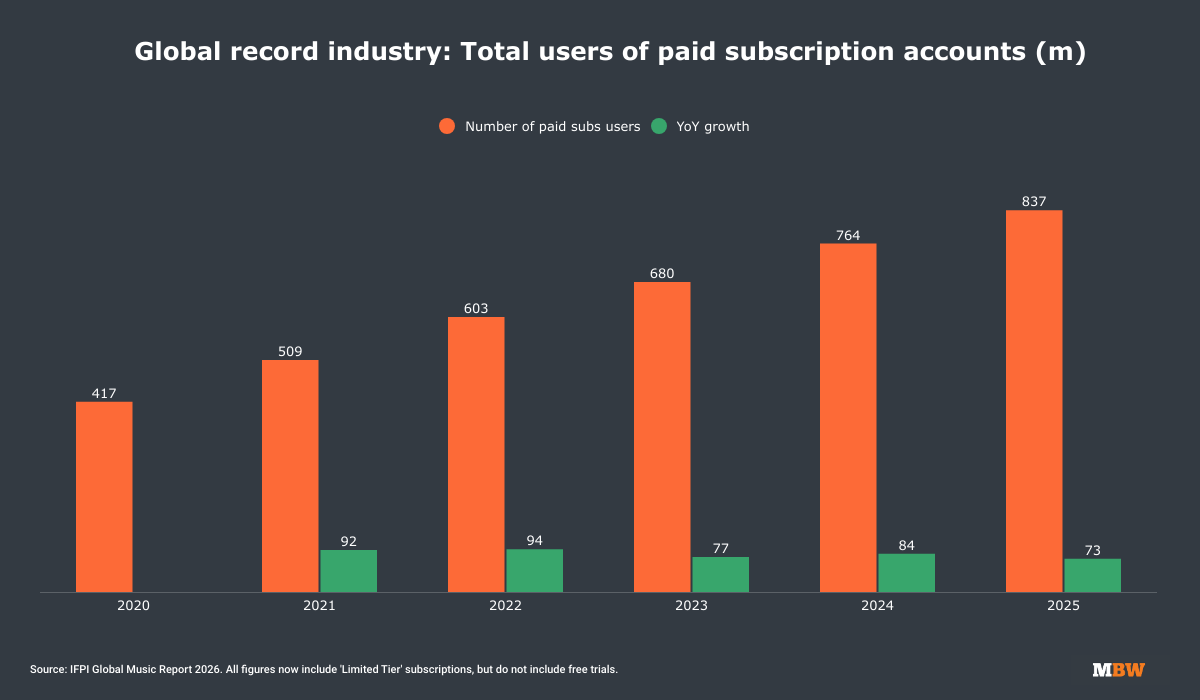
The total number of users of paid music streaming subscription accounts grew to 837 million globally in 2025, up from a restated 764 million in 2024 — an increase of 73 million accounts in a single year.
The pace of net subscriber additions has fluctuated, from 94 million in 2022 to 77 million in 2023, 84 million in 2024, and 73 million in 2025 — but the industry continues to add tens of millions of paid accounts each year as it inches closer to the 1 billion milestone.
This chart has been updated to reflect adjusted retrospective annual figures from IFPI’s GMR 2026
9. Sync declined, downloads continued to fade — but performance rights grew modestly
Not every revenue format grew in 2025.
Synchronisation revenues — derived from the use of recorded music in films, TV, advertising, and gaming — declined 2.0% YoY after four years of successive growth, totalling USD $641 million. Sync accounted for 2.0% of global recorded music revenues.
Downloads and other digital revenues continued to decline for the 13th consecutive year, falling5.0% YoY. These formats now account for just 2.5% of global recorded music revenues, reflective of a market where fans are increasingly streaming music.
Performance rights revenues — collected by music licensing companies and derived from the use of sound recordings and music video, mostly in public performance and broadcasting — reached USD $2.9 billion in 2025 and grew by a modest 0.3% YoY, marking the fifth successive year of revenue growth.
Performance rights generated 9.3% of total global industry revenue.
10. AI innovation and streaming fraud will shape the next chapter
IFPI’s report highlighted two key themes shaping the industry’s future.
On AI, IFPI says record companies are at the forefront of the next generation of AI innovation, actively engaging in the development of music licensing models to generate revenue opportunities for artists — aiming to build an ecosystem where AI and human artistry thrive together.
On streaming fraud, IFPI warns that the industry faces an increasing threat from bad actors artificially generating plays for manipulated or fake content, siphoning vital revenues away from artists and others who power the music economy.
“The entire music community must take action to tackle the threats facing our industry.”
Victoria Oakley, IFPI
Victoria Oakley, CEO of IFPI, said: “The entire music community must take action to tackle the threats facing our industry.
“Streaming fraud is theft, plain and simple. The organisations with the data, scale and leverage to prevent this fraudulent activity, including streaming services, content aggregators and distributors, must take decisive action.”Music Business Worldwide